• Welcome to AppraisersForum.com, the premier online  community for the discussion of real estate appraisal. Register a free account to be able to post and unlock additional forums and features.

As-is Vs. Prospective Stabilized Discount Rate

Normally, when doing an As-Is (Year 1-10) and a Prospective Stabilized (Year 2-11) DCF:

  • The "As-Is" cash flow discount rate should be higher than the stabilized.

  • A Prospective Stabilized cash flow discount rate should be higher than the "As-Is".

  • The same discount rate for both As-Is and Prospective Stabilized cash flows.


Results are only viewable after voting.
Status
Not open for further replies.
As we talked about, I thought about this and when you first asked the question. In my mind I thought of a phase project. One part relatively new and 100 percent occupied compared to the second phase not constructed yet. To me the new phase is riskier given no one knows the future and it takes about a years to construct the average commercial project..

But if you consider a 30-year old development that is falling apart and people are moving due to its crappy condition, rates could be the other way around. So it seems to me answers are based on what people think you mean or what type comparison is being made.

However, if you narrowed the question down to an mock situation where comparison can be drawn instead of imagined I bet you would get a tighter response in one direction or another. Because if you think about it it actual could be either way depending on the projects being compared. Just a thought.

But for anyone to say it is always higher or lower really does not know what they are they are saying. I believe; it depends on the projects being compared.

Further, it is just math, If discount rates are higher going in cap rates are lower and vice versa. It is the same way in all models. The terminal rate general falls somewhere in the middle of the two within the model but it could be higher or lower depending on where investors believe the market is going.
 
Now I'm confused. The title refers to a 10/ 11 year DCF, but the original post talks about a 12 or 24-month DCF to stabilize below market rents? What type of property are we discussing exactly?
 
Now I'm confused. The title refers to a 10/ 11 year DCF, but the original post talks about a 12 or 24-month DCF to stabilize below market rents? What type of property are we discussing exactly?
When you run an Argus, you can set a secondary date of value. You typically do this if you have a property that is not stabilized. So you would set up the cash flow, then if your property stabilizes in 24 months, you would set the secondary date of value to start on the 25th month and run through the end of the DCF. You can utilize different discount rates for the prospective value, which is what the OP is asking. Should he or shouldn't he?
 
When you run an Argus, you can set a secondary date of value. You typically do this if you have a property that is not stabilized. So you would set up the cash flow, then if your property stabilizes in 24 months, you would set the secondary date of value to start on the 25th month and run through the end of the DCF. You can utilize different discount rates for the prospective value, which is what the OP is asking. Should he or shouldn't he?
Maybe so, but I tend to agree with Stephen in that a blanket yes or no statement might not be appropriate throughout different markets and property types simply on a basis of below market rents with a limited term. Who the most likely purchaser is can weigh heavily on the reaction. If it is a larger multi-tenant property where an investor is the most likely purchaser, the reaction would most likely differ than if the most likely purchaser is the tenant or an owner occupant of a smaller property.
 
I agree to an extent, blanket statements in the appraisal world are problematic when it comes to methodology. However, most of the time when you are running an Argus, the most likely buyer is an investor.

I think the question is appropriate. My former employer liked to shift the discount rate downward on the stabilized cash flow stream 25bps. It's not going to move the world to do that and one could certainly make a solid argument for it. If I were reviewing an appraisal that did that, I don't think I would blink twice. Same goes the other way (keeping the rate the same in the "as is" and prospective).

If nothing else, Michael knows that whatever he does is probably appropriate assuming there is a reasonable explanation. There definitely wasn't a consensus.
 
I've heard the argument that the prospective cash flow represents less risk and the discount rate should be lower. However, moving the discount rate in a 10-year cash flow penalizes the future income beyond right-sizing the rent or performing a lease-up for an under-performing property. If your lease-up or below market rent was going to take 5+ years, I might consider moving the discount rate. Otherwise, you are modeling the risk with your assumptions on absorption time, TI's, and free rent. The discount rate has a lesser effect during lease-up (Y1 & Y2).

I have seen a lot of these and backed into the prices that participants pay for value-add properties. The discount rate hardly ever has to be adjusted if you are modeling it properly. Most of the time, the most significant items to consider are turning over below market leases, significant cap ex, hefty TI allowances, and free rent. Value-add investors want to incur these items as soon as possible so they can stabilize and flip the property.

Yep, I have gotten this from every institutional client I've interviewed. They don't even model vacancy for existing tenants. The consensus is your market leasing assumptions should take into account all of this, and your discount rate should be based on the stabilized rate for the asset class.

Now, this is institutional grade stuff. I also agree if you had something really weird 5+ years out, it may be prudent to use a different discount rate.

One thing I have been doing in challenging submarkets that, in the long term, I think will improve is to lower TIs and free rent over the initial 5 years. I learned this trick from acquisitions guys at institutional firms.
 
Yep, I have gotten this from every institutional client I've interviewed. They don't even model vacancy for existing tenants. The consensus is your market leasing assumptions should take into account all of this, and your discount rate should be based on the stabilized rate for the asset class.

Now, this is institutional grade stuff. I also agree if you had something really weird 5+ years out, it may be prudent to use a different discount rate.

One thing I have been doing in challenging submarkets that, in the long term, I think will improve is to lower TIs and free rent over the initial 5 years. I learned this trick from acquisitions guys at institutional firms.
Interesting take! I'll keep that in the back of my mind.
 
Thanks for the replies. I recall literature on this topic, and that's probably where this "rule of thumb" comes from. Before I look it up, I'm going to guess that the article(s) will read as though a typical 10-year DCF with ongoing tenant rollover is a predictive-budget for the future, and the fact is never mentioned that a typical multi-tenant lease-by-lease analysis is just a probabilistic forecast that WILL turn out to be wrong. REPEAT: probabilistic lease-by-lease analysis can't correlate with actual performance (exceptions being very simple runs with no rollovers). It can't - the Y2-11 forecast is very risky because it is a fact that it will be wrong.

Regardless, too many new appraisers dropped into lease-by-lease analysis to "learn on the job" think this way (that a lease by lease DCF is a rigid prediction). It's so easy to fall into the trap of thinking we are budgeting the future as though Argus or FUEL DCF are accounting programs. I proved to myself the opposite when involved in informal training seminars on Project and Argus during my MA at UF (the old Appraisal Institute accredited program), and later at a Dow Jones startup (Teleres). When running through academic exercises outside of production-deadline pressure it becomes very apparent that a lease-by-lease analysis 10-year DCF will always - ALWAYS - be very different from the eventual reality (mostly because of the "renewal" and "downtime between leases" assumptions).

Yes, in a perfect predictive DCF - if anything - we would weight the Y1-10 DCF discount rate higher because of risks associated with greater change due to stabilization (thus the math, where the discount rate = OAR plus average NOI change rate). So that's one for that argument.

BUT, understanding how profoundly WRONG any DCF will be (must be) in predicting 10-year cash flows correctly, the risk (variance or average rate of change) grows exponentially from the prediction with time - FROM THE PREDICTION, NOT WITHIN THE MODEL. That is why I frequently weight the stabilized (i.e. Y2-11) discount rate higher. The math DOES work out because it's an entirely new DCF almost unrelated to Y1-10 assumptions, and we would be justified in recognizing that the risk factor in the Y2-11 OAR (yes - the cap rate) should increase the discount rate base considerably (then you can add your average change rate).

So:
Y1-10 discount rate = Market OAR + large variance in NOIs, and
Y2-11 discount rate = Hypothetical Stabilized OAR + lower variance in NOIs.

Now consider that because we use a higher terminal OAR, that's the basis for the average change rate (not the lower going-in OAR). This is where the increase in the Y2 discount rate comes from - not the variance.

The Hypothetical Stabilized Y2-11 terminal OAR carries the most risk in these chains, and either increases or mitigates a change between the Y1 and Y2 DCFs. I'd argue that we aren't weighting that terminal cap rate enough, but that's a different discussion because "this is how the market and appraisal report consumers do it" (and I'm fine with that).

Now, somebody clean and write this up for submission to the publication(s) that originally misguided a generation or two (including quite a few of us old-geezers).

Oh, and one more thing - discount rates are expected to increase, so that's another reason to use a higher Y2-11 discount rate. So, it would be even more difficult to justify a lower Y2-11 discount rate.
 
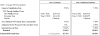
In case anybody is still reading this thread, I've "finalized" my thoughts on this issue and - because I'm a hopeless wonk - added the attached table to my template to explain my discount rate estimates. You'll recognize the top half where we're adding the OAR to the average change rate in NOI. I'm also including an adjustment for the prospective discount rate trend. Depending on the NOI trends and magnitude of the adjustment - still a work in progress - the Y1 discount rate will usually be higher bur can also be equal or even the other way. However, this changes my initial leaning toward going with a higher future stabilized rate for obvious reasons. Don't worry about the Estimated Discount Rate or basis point note at the end - the important thing is the indicated discount rate.
upload_2019-3-7_16-0-6.png
 
You can not have multiple discount rates for the same model. Otherwise, the rate of return is different depending upon which year you are looking at in the model. The return of the cash flow can not change year-to-year.
 
Last edited:
Status
Not open for further replies.
Find a Real Estate Appraiser - Enter Zip Code

Copyright © 2000-, AppraisersForum.com, All Rights Reserved
AppraisersForum.com is proudly hosted by the folks at
AppraiserSites.com
Back
Top