• Welcome to AppraisersForum.com, the premier online  community for the discussion of real estate appraisal. Register a free account to be able to post and unlock additional forums and features.

Sales Comparison Grid & Cost to Cure

Status
Not open for further replies.
That is the point. A - where are you going to find "paired sales" outside a huge metro area.
The OP says Sales Grid. That means Market Value. That means sales comparables.

B - I have seen contracts where money is escrowed to repair certain items to a set max or min.
Maybe. But just because a contract escrows $15K to repair stucco does not mean that the repair work is worth that. The owner(s) decided to buy the house $650K for sundry reasons. Then they get a home inspector to inspect it and he comes of with a list of defects they did not see (they are out of state and have not seen the house, except through a virtual tour). They then negotiate with the seller to repair or compensate them for the defects. They may have 5 things of importance, (1) Stucco on a part of the house that is has cracks that could leak water, (2) 2 defective A/C units (let's say in good old hot Texas), (3) 3 Windows in need of repair and so on. That $650K was for the house assuming it didn't have the defects. Now they want them fixed. You know what? The owner has to fix them whatever it costs - that is not their problem. You know what? The seller could even lose money. So they get a cost estimate for the stucco that says $15K to repair. They demand that from the seller to close contract at $650K. So where are you now?

C- the book (real estate appraisal text books - all of the good ones) will tell you that a cost related adjustment is a real thing.
The Crappy books are crap much of the time. You take them with a grain of salt. Some authors are reputable and others are not. But anyway, what does a "cost related adjustment" have to do with the Sales Grid? IT DOES NOT. Why. Well an adjustment is the difference between the value contribution of a given feature for the subject and a comparable. In light of this, you do need to make your numbers work. The way not to do that is to throw in some cost adjustment out of nowhere. You do that in the sales grid - you really don't know what you are doing. And most appraisers don't. There is a way to do this sort of thing correctly -- and no you don't absolutely have to have comparables for every little feature you want to adjust.

The fact is EVERY kind of adjustment has some sort of caveat or flaw. Trend analysis, Multilinear regression, paired sales. On and on.
No, not necessarily. I once did a condo and MARS regression said the GLA was such and such. All prices were set by the condo management and they told me they used the same formula my regression reported. It was a tight and closed case of course.

D - what flippers and rehabbers do is not an issue. They are bottom feeders to begin with. They also are often specialized in making cosmetic repairs that a home owner would not tolerate. I saw one restretch and deep clean a carpet that I had assumed needed replaced. Didn't look bad but a year later it obviously was not much better than I thought it was. Then they may rent to own and sell accordingly. They pay less, they spend less and they make sure they have a cushion - otherwise they lose their butts.
Beside the point.
So perhaps I should ask this question....

How many extractions or paired sales do you need to be "accurate"?
For MARS regression, because of the more complex models generated, you need as a rule of thumb 10 sales transactions per predictor. Data Mining operations partition the data sets into typically 90% for training and 10% for testing. So, if your data set has 6 predictors you need (10*6)/0.90 transactions or about 67 sales. You can go back several years and expand to the market area. Now if you don't have 67 sales, you can cheat and duplicate the ones you have. However, that will make your performance indicators (R2, GR2 and GCV) look better than they really are. But, that is simply the best you can do (invariably better than matched pairs) and nothing can work better - for the SCA.


Now of course you have the Cost Approach and the Income Approach. For what they are worth.

If you haven't come up with a fireplace adjustment from negative $5000 to $30,000, then you've not done many such analyses. How many times does a paired sale come up $50, $85, and $70... so is the adjustment $50 or $85 a square foot, or what point in-between? That's $35/SF - an $85,000 difference on a 2,400 SF home. These are dart board adjustments. You can justify your choice as SUPPORT for an adjustment, but not as a true accurate PROVEN adjustment. Ditto C2C. It's not exact, but it is SUPPORTED BY REAL COSTS not adjusted by the whim of the appraiser.

If you say "Flippers typically add 20% to the cost as EP" then back it up. You can't. You won't get a contractor to make such a foolish statement. So how do you defend it in a report nor in a court. The truth is flippers don't use the same metrics we do. Not by any stretch.
Off subject.
 
Last edited:
One of the fundamentals of appraisal is that value does not equal cost (though it can in some cases ).
Look that up in the Appraisal of Real Estate :)
The very first tenant of USPAP Std 1-1 is "to be aware of, understand, and correctly employ those recognized methods and techniques that are necessary...'
So where do you get such recognized methods and techniques if not from text books? The Selling Guide and 4000.1 are guides only to their respective sources - FNMA and FHA. They are not the end all. They also don't speak much about repairs to they other than you need to ID the repair and caveat the report accordingly. USPAP admits it isn't a textbook.

Nothing I've ever read in print in any class or book has challenged the idea that cost to cure is an adjustment. Yes, you CAN make an adjustment under the assumption that there must be Entrepreneurial profit, or some magical discount to cost that the "market" will pay. But how and where do you pull that discount out of the air? Well USPAP has something to say about that too...

"analyze such comparable data as are available to estimate the cost new of the improvements (if any) -​

...and when are there no such data to make that adjustment? Throw it out and guess? It is the best support you have. Maybe in a huge metro area, with thousands of listings, you might locate 5 or 10 such properties sold during a re-roofing. And again, I bet a scatter diagram of the costs would range widely.... which basically renders it into a wild guess within a given range of numbers. Is that really better than a fixed cost?

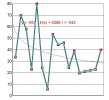
It is really no different from a multi-linear regression. The plot will show a scattering of the data and then an arbitrary line based on the mean is drawn. From that we make an adjustment- So if you plot a series of "paired sales" what do you get - something like this which shows if you actually use ALL the pairs you have, it's likely to look like anything from zero to $80/SF and how accurate is that? Just because I put a log trend line over it doesn't make any number there of any consequence whatsoever. It only kinda suggests those are the likely low and high ranges.

We try to limit this by picking and choosing what we want to call the "best" pairs. But is that process any better than a fixed cost? How?
trend line.JPG
 
Looks like a lot of appraisers are comfortable using cost adjustments in the grid. Seems like an easy solution - and if this group is a representative sample of appraisers overall then the industry must accept it.

Still doesn't seem to correlate with how we were instructed to calculate adjustments in the sales comparison approach - gonna touch base with a contact at the appraisal board and see what they say. Will report back with findings.
 
Looks like a lot of appraisers are comfortable using cost adjustments in the grid. Seems like an easy solution - and if this group is a representative sample of appraisers overall then the industry must accept it.

Still doesn't seem to correlate with how we were instructed to calculate adjustments in the sales comparison approach - gonna touch base with a contact at the appraisal board and see what they say. Will report back with findings.
You need a balanced approach in order to survive. Your business model dictates a requirement to fish or cut bait. Endlessly analyzing a problem will violate that requirement quickly.
This profession is as much of a art as it is a science with imperfect data sources and inadequate tools to analyze that data. Ultimately it's a roof, it's simple, deal with it and move on.
 
Still doesn't seem to correlate with how we were instructed to calculate adjustments in the sales comparison approach -
Who taught you? I mean - there are both qualitative and quantitative adjustments. There is no such thing as a single method to adjust. This is just standard teaching in the sales approach classes. I wonder how appraisers get the idea that there is only one way to make adjustments and how they think that neither income nor cost data are "market data" and only sales are market data.
 
Who taught you? I mean - there are both qualitative and quantitative adjustments. There is no such thing as a single method to adjust. This is just standard teaching in the sales approach classes. I wonder how appraisers get the idea that there is only one way to make adjustments and how they think that neither income nor cost data are "market data" and only sales are market data.

They taught various methods for calculating adjustments in all three of the approaches to value - never once have I used, been taught, or even heard of (until two days ago) applying a cost based adjustment in the sales grid. 7 years - more than 2,000 appraisals. Cost based adjustments aren't the mystery here - using them as the basis for line item adjustments in the sales grid (sales comparison approach) is. Huge red flag - but hey, way easier. I hope this is standard / acceptable practice because it would be WAY easier to base adjustments on costs than endlessly digging through comps for, you know, market derived / supportable adjustments.
 
Looks like a lot of appraisers are comfortable using cost adjustments in the grid. Seems like an easy solution - and if this group is a representative sample of appraisers overall then the industry must accept it.

Still doesn't seem to correlate with how we were instructed to calculate adjustments in the sales comparison approach - gonna touch base with a contact at the appraisal board and see what they say. Will report back with findings.

The problem with using cost based adjustments in the Sales Grid - is that they can get WAY out of control fast. There is just too much nonsense floating around in people's heads. This solves the problem: A pure MARS regression approach based on these constraints:

1. All adjustments through feature value contributions where those contributions for each comparable have to add up to the net sale price.
2. All unmeasured variable value contributions have to equal the residual.

Those two constraints will lock you down and prevent you from pushing values too high or too low. In fact by using them all adjusted sale prices will be exactly the same. Pure mathematics.
 
They taught various methods for calculating adjustments in all three of the approaches to value - never once have I used, been taught, or even heard of (until two days ago) applying a cost based adjustment in the sales grid. 7 years - more than 2,000 appraisals. Cost based adjustments aren't the mystery here - using them as the basis for line item adjustments in the sales grid (sales comparison approach) is. Huge red flag - but hey, way easier. I hope this is standard / acceptable practice because it would be WAY easier to base adjustments on costs than endlessly digging through comps for, you know, market derived / supportable adjustments.
... and just to be clear - normally when we provide cost to cure estimates we do so as lump sum supplemental adjustments in the cost approach with detailed explanation in the addendum. This isn't my first run in with cost to cure - its just the first time I was asked to line item it in the grid.
 
I disagree, the client can not instruct the appraiser to make separate line adjustments and it is not just a reporting issue !! It is an appraisal issue, they are telling the appraiser to appraise it this way , (with a separate roof adjustment ) ( and the appraiser says yes )

If the appraiser decides independently that making a separate roof adjustment is the credible approach, that is different than the client instructing them to do it that way.

BTW, imo the correct approach would not be a prospective valuation (I was addressing this , which you did advise) -
Again... I disagree. Appraisers take instructions on reporting from Clients all the time. "Include the 1004MC" "We need comments about...." As long as the report complies with USPAP, it's fine. Telling an appraiser to separate completetion or repair adjustments... or even the adjustment for a specific repair... is not a violation. IF the Client tells the appraiser that the MUST make an adjustment or how large the adjustment should be.... then, yes... thta is a problem.
 
Again... I disagree. Appraisers take instructions on reporting from Clients all the time. "Include the 1004MC" "We need comments about...." As long as the report complies with USPAP, it's fine. Telling an appraiser to separate completetion or repair adjustments... or even the adjustment for a specific repair... is not a violation. IF the Client tells the appraiser that the MUST make an adjustment or how large the adjustment should be.... then, yes... thta is a problem.
Again,, reporting or appraisal
the OP's client asked them to ADD an adjustment that was not there before !! They then told the appraiser to base it on cost 1) The adjustment did not exist before.. 2) An adjustment can change the value That is appraisal. Moving the cost adjustment up or down a line on the grid is reporting,.
 
Last edited:
Status
Not open for further replies.
Find a Real Estate Appraiser - Enter Zip Code

Copyright © 2000-, AppraisersForum.com, All Rights Reserved
AppraisersForum.com is proudly hosted by the folks at
AppraiserSites.com
Back
Top