

ItDepends
Freshman Member
- Joined
- Dec 2, 2022
- Professional Status
- Appraiser Trainee
- State
- Massachusetts
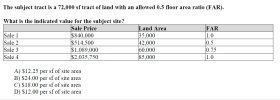
The answer key says it's D, $12.00/SF. This is the route they take to arrive there:
1. $840,000/35,000SF=$24.00/SF
2. 42,000*0.5=21,000 SF
$514,500/21,000SF= $24.50/SF
3. $60,000 x 0.75=45,000 SF
$1,089,000/45,000 SF= $24.20/SF
4. $2,035,750/85,000SF=$23.95/SF
Mean = $24.16
72,000 SF x 0.5 = 36,000/SF
36,000 SF x $24.16 = $869,850
869,850 SF/72,000 SF = $12.08
I answered A, $12.25/SF. This was my route:
1. $840,000/35,000 SF = $24.00 (FAR 1.0)
2. $514,500/42,000 SF = $12.25 (FAR 0.5)
3. $1,089,000/60,000 SF = $18.15 (FAR 0.75)
4. $2,035,750/85,000 SF = $23.95 (FAR 1.0)
My logic was that land with a greater legally permissible FAR might sell for more per unit because of the greater development potential, and the resulting $/SF data appears to clearly indicate that is true. Since the subject in the question has a FAR of 0.5, I concluded it was more reasonable to use the comp with a FAR of 0.5 exclusively rather than average them all out.
Where am I going wrong here?

