• Welcome to AppraisersForum.com, the premier online  community for the discussion of real estate appraisal. Register a free account to be able to post and unlock additional forums and features.

Wood foundation

Status
Not open for further replies.

CSP 49

Member
Joined
Dec 2, 2008
Professional Status
Certified Residential Appraiser
State
Florida
Never ran across a property with a wood foundation until this week. I really though I was misreading the report but the foundation is made of wood, this is a newer house built in 2005. After Googling I found houses are built and it appears this can be a sound type of construction but I personally wouldn't do it.

Does anyone appraiser in a market where wood foundations are typical and is there a variation in pricing vs. concrete foundations? It seems there would be market resistance.
 
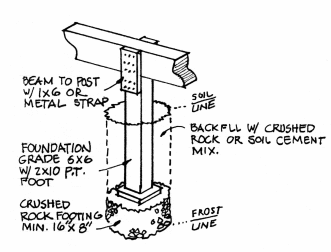
Wood foundation? Do you mean like Post and Beam? Or a pole type building
We have a lot like the one on the right completed as a house and it floats a slab between the poles ... It's about $15 a SF cheaper and I use the min-std catagory in the cost approach to match the owner's actual costs. See them in rural areas of E. Oklahoma the most.

img4new.gif
pole-shed-design-1.jpg
 
I have seen it a couple times. No difference in value from the couple I have seen.
 
Wood foundation? Do you mean like Post and Beam? Or a pole type building
We have a lot like the one on the right completed as a house and it floats a slab between the poles ... It's about $15 a SF cheaper and I use the min-std catagory in the cost approach to match the owner's actual costs. See them in rural areas of E. Oklahoma the most.

img4new.gif
pole-shed-design-1.jpg


That was my firt thought too, post and beam with a different way of identifying it. But, that's not it. The house has a basement and the foundation/basement walls, etc. are made of wood. Basic construction is that gravel is placed underneath and several feet up the side walls to allow water to perc. The exterior of the wall is covered in plastic.Wood is treated with some type of poisonous salt that prevents termites, fungus, etc.

In theory it seems plausible but I would never personally use the technique. Even if the construction can be sound how many people could execute it correctly?

The house was in Michigan but I forget where.
 
It is still allowed under most codes IIRC. The idea was that it was cheaper in areas where concrete was scarce or expensive, and the carpenters could install it rather than a special concrete crew or masons etc. The inherent weakness is that when the waterproofing fails, and it eventually will, wet wood is more susceptible to bending and loses some of its rigidity, causing the walls to bow under the weight of the soil that prior to the wood getting wet, it was capable of resisting.
 
There a a couple of subdivision of them in my area. The studs went down to the footer (about 3 feet underground) and had treated plywood on both sides. They were built to be entry level homes of 1200 to 2500 square feet one, split and two story. One of the builders is this area used the whole crawl space as the return duct to the furnace. Since I am in an area with quite variable moisture (and often high soil moisture) many crawl space and foundation problems sprang up. They sell at a discount to standard construction in the 5 to 15% range depending on current condition. One or more builders of this style foundation are now bankrupt. If maintained and ductwork installed the houses are competitive.
 
I've seen the wood crawl space foundations and basements.

Most of the wood crawl spaces in this area were built in a couple of subdivisions of starter homes, 1200 s.f. ranches, $100K price range, and were being built in about 1990-2000. They definitely suffer from a stigma and lower prices compared to conventional concrete slab or concrete block crawls. The effect is 10% +/-.

Wood crawls were: conc foundation below freeze, 2x8 bottom plate, 2x8 studs to above grade level, and 3/4" treated plywood for the exterior with gravel backfill. All wood allegedly treated to a higher than normal level. Also some tri-levels and bi-levels had the same foundations for the lower levels. They sold well because of the below market interest rate (neg-amortization in some cases; wildly adjustables in others) but the original buyers soon found out that they are not well received on the resale market.

The two wood basements I've seen were under relatively expensive homes (2-3X avg. price) but the buyers didn't seem to care and there was no obvious sales price effect.
 
The house I had in Alaska had a wood foundation and wood basement walls. No problems.
I think I remember seeing something that FHA is ok with them. I can't, right now. point to where I saw it though.
 
There are plenty in northern climates, popular during the 1970's energy spikes since they are warmer, easier to insulate.

It must be a PITA to size them up for a home inspector. The gravel necessary below & as back fill much of the way up the wall may have been skimped, for example.

If everything was done to spec they should last a long time, century or more. But, how often does that happen? Even Hardie Board, touted as semi-bullet proof, deteriorates when not installed to spec, which is probably often.

Market reaction? Dial it in locally as always. Well informed buyers should be wary of it compared to more predictable outcomes with concrete block or poured concrete foundations.
 
never seen a wood foundation, but i have seen a house built on a wood deck. the homeowner was a contractor, he built a large deck then built a 1 story home on top of it.

he said the decking was higher quality than a normal deck. this was years before i got into the appraiser profession and dont remember any specifics.
 
Status
Not open for further replies.
Find a Real Estate Appraiser - Enter Zip Code

Copyright © 2000-, AppraisersForum.com, All Rights Reserved
AppraisersForum.com is proudly hosted by the folks at
AppraiserSites.com
Back
Top