• Welcome to AppraisersForum.com, the premier online  community for the discussion of real estate appraisal. Register a free account to be able to post and unlock additional forums and features.

Evaluations 1, Appraisals 0

Status
Not open for further replies.
The areas such as your brothers house that he sold for less than 2004 can lead prices higher over the next decade. IMO
 
Did rents crash with home prices in 2008?

Nope, they went up, more people chasing the rental market. That's your hedge. Prices crash, rents rise. The more people get burned in ownership, the better for the landlord. During the runup, was my worst time getting good tenants. Anyone and everyone was able to buy.

If one is well capitalized, to withstand some shocks, RE is STILL pretty much a long term sure thing, especially if financed 80/20.
 
Anyways if there is a pull back in prices I generally agree with you that it would be more like 90's than 2000's. I don't think we are getting even that soon. I am thinking what is likely is in the areas that lead price increases from the bottom start to stabilize and prices start increasing in areas that have not recovered yet.

It hasn't worked that way yet. These different market segments have entered and exited the prevailing trends at different times so a secondary market that entered into increase later than the primary markets might continue to show some gains until they catch up with the prevailing trend for decrease (and vice versa when the market is moving in a different direction). A lot of the devotees of the various "fabulous wealth building systems" that were being hawked in late-nite infomercials were moving from top tier to secondary and tertiary markets trying to promulgate those programs as the top tiers played out, but they didn't get anywhere before those lesser markets eventually joined in with the prevailing trends.

These market segments don't move in sync (at all), but neither are they completely disconnected from one another.
 
The millennial disadvantage is real: Most millennials are worse off financially than parents

Most millennials will struggle to earn more money and find better jobs than their parents despite being more highly trained, according to a Credit Suisse study


http://business.financialpost.com/p...worse-off-than-parents-despite-aptitude-study

Going forward, who are going to be buying houses? Not the millennial generation. That means that the number of houses are like the number of appraisers are like the number of millennials: Too many unaffordable houses, too many appraisers and too many millennials with incomes that can't support the current value of houses.
 
The areas such as your brothers house that he sold for less than 2004 can lead prices higher over the next decade. IMO
Not a chance. Trends for increase start from the inside (close to employment centers) and work their way out to the rural areas; whereas trends for decrease start from the outside and work their way in. His house in more/less in the middle relative to the employment centers.

The markets have already been on an increasing trend for 3-4 years in most areas. Some or all of them may go on for a couple more years but in no case will we see a 10-yr bull run without incurring a commensurate correction afterwards, let alone the 14yr (existing 4 + 10 more) run you are suggesting here. It's never happened before and there's no reason to assume that it even can happen.

The bust of 2007 occurred after a 9-yr run and the subsequent correction was catastrophic precisely because of its excesses. Had it ended at 4 years (2002) instead of 9 that correction would have been similar to the 1990 bust.

You know all those investors who bought low and are holding? What do you think they're going to do when there's no more upside for them? Sell, right? That's where your excess inventory is going to come from.
 
Last edited:
What I am seeing is that active listings declined across the board ti shortage levels in 2012 and all prices came off lows. Then from there active listings in desirable / prime location areas flattened out at shortage levels and remain there today. In the less perfect locations, the active listings increased and prices stabilized off lows but did not continue higher to new highs. But in the less perfect locations active listings are now back to shortage levels. So this is why now the regional active listing data is showing fresh lows. I think the areas that did not fully recover now begin moving back to prior highs and eventually to new highs.
 
upload_2018-4-22_16-37-49.png

Above is active listings of townhomes in 20002 which is part of area around downtown.

upload_2018-4-22_16-37-37.png

Above is active listings of townhomes in 20874, a further out suburb where prices have not fully recovered.

I would bet that active listings charts look like 20874 for any place around large markets where prices have not recovered and look like 20002 in any place where prices are at record highs.
 
Did rents crash with home prices in 2008?

Nope, they went up, more people chasing the rental market. That's your hedge. Prices crash, rents rise. The more people get burned in ownership, the better for the landlord. During the runup, was my worst time getting good tenants. Anyone and everyone was able to buy.

If one is well capitalized, to withstand some shocks, RE is STILL pretty much a long term sure thing, especially if financed 80/20.
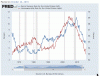
Homeowners slide and renters rise

Homeowners slide and renters rise.gif

People lost their homes and rented them back. Wall Street bought foreclosures and turned them into rentals.
 
Not a chance. Trends for increase start from the inside (close to employment centers) and work their way out to the rural areas; whereas trends for decrease start from the outside and work their way in. His house in more/less in the middle relative to the employment centers.

The markets have already been on an increasing trend for 3-4 years in most areas. Some or all of them may go on for a couple more years but in no case will we see a 10-yr bull run without incurring a commensurate correction afterwards, let alone the 14yr (existing 4 + 10 more) run you are suggesting here. It's never happened before and there's no reason to assume that it even can happen.

The bust of 2007 occurred after a 9-yr run and the subsequent correction was catastrophic precisely because of its excesses. Had it ended at 4 years (2002) instead of 9 that correction would have been similar to the 1990 bust.

You know all those investors who bought low and are holding? What do you think they're going to do when there's no more upside for them? Sell, right? That's where your excess inventory is going to come from.

I agree with your first paragraph. So we have the (close to employment centers) areas that led us out of the crash and now further out areas are getting pulled up.

I don't know about the rest of the post. I will look into that. I am not even sure what defines the end of a bull run for real estate. From what I looked at recently, it looked like prior to 2008, there were two times that there was around 10% decline in prices and that was 70 and 90. 70's lasted a couple quarters and 90's was a few years.
 
Status
Not open for further replies.
Find a Real Estate Appraiser - Enter Zip Code

Copyright © 2000-, AppraisersForum.com, All Rights Reserved
AppraisersForum.com is proudly hosted by the folks at
AppraiserSites.com
Back
Top
