• Welcome to AppraisersForum.com, the premier online  community for the discussion of real estate appraisal. Register a free account to be able to post and unlock additional forums and features.

"Quantifiable Market-Derived Methods" for adjustments required by FNMA/USPAP

I would expect that significant differences are supported by data and logic.

Like here is how I support a lot size adjustment. You can see that the value of 1.2 acres is around $2 million and the value of a half acre lot is around $1.1 million. 6611 Lybrook Ct sold for $1.45 million but it was permit approved and shovel ready. So if your subject is a half acre lot in this neighborhood, and your comp is a one acre lot, then the adjustment would be around $900k.

View attachment 103038
I assume these are land sales? Most neighborhoods in the NJ/CT/NY area don't have enough land sales to produce something like this for support. How do you support your site adjustments when there are basically no land sales available?
 
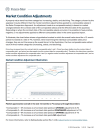
Analyzing market conditions is a fundamental requirement of STD 1. The fact that the change (if any) is "insignificant" should be a conclusion based on data/analyses, not an assumption.

View attachment 103040

I think ignoring a SR does matter, but some might not agree.

Of course you have to analyze it. It is the GSE trying to tell you how it must be analyzed and reported that is misguided and super annoying.
 
I assume these are land sales? Most neighborhoods in the NJ/CT/NY area don't have enough land sales to produce something like this for support. How do you support your site adjustments when there are basically no land sales available?

These are properties improved with tear downs that were aquired by builders for new construction.. which are land sales. It would be similar in NJ, CT, NY in areas that are fully developed.
 
It is the GSE trying to tell you how it must be analyzed and reported that is misguided and super annoying.
And where have they done that? I am not aware of any specific required analysis or reporting.
 
Most seasoned appraisers use quantifiable techniques all the time. Bracketing is a quantifiable technique (also called sensitivity analysis). Both grouped sales and paired sales are quantifiable techniques - and they really work. Regression is a quantifiable technique that more and more appraisers are adopting. It's been my experience that citing 'experience' as support for an adjustment is just lazy (or someone doesn't know how to employ quantitative techniques).
I always considered paired sales to be great in theory - but how exactly do you eliminate the influence of multiple differences between two properties to confirm the value of a single item such as a fireplace, ig pool, finished basement, etc.?
 
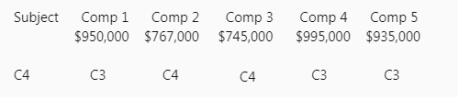
Subject Comp 1 Comp 2 Comp 3 Comp 4 Comp 5
$950,000 $767,000 $745,000 $995,000 $935,000

C4 C3 C4 C3 C3 C3


The condition adjustment between C3 and C4 would be around $200,000.
Help me understand this. What if there are 20 other signficant differences between these properties that, combined, account for their difference in sale price? How is the $200k difference in sale price accounted for by condition alone? What if Comp 1 is a 3,000 sqft colonial on two acres with a finished basement and ig pool while Comp 2 is a 2,000 ranch on a slab, no pool, and on .5 acres? Would the condition adjustment be around $200k?
 
View attachment 103041


You don't remember this one? :)
That is an illustration for discussion of the issue, not a requirement. :)

There is no requirement for a graph of any kind. There is no requirement for analysis of any specific type of data. It is up to the appraiser to decide the appropriate level of analysis and to include that in the report.
 
Find a Real Estate Appraiser - Enter Zip Code

Copyright © 2000-, AppraisersForum.com, All Rights Reserved
AppraisersForum.com is proudly hosted by the folks at
AppraiserSites.com
Back
Top