• Welcome to AppraisersForum.com, the premier online  community for the discussion of real estate appraisal. Register a free account to be able to post and unlock additional forums and features.

Anyone care to educate me on developing the As-Is value mid new construction?

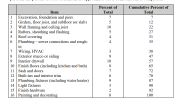
Problem identification is going to be a significant issue in this type of assignment. Understanding what you're seeing WRT what has already been completed vs incomplete. That's where having a table like this might come in handy:

Completion by COST

1773430312510.png
 
Again, much of it is a stab in the dark and the appraiser should explain their decision to discount or not discount and why.
Much like using depreciation tables to establish market value of special use improvements without any sale data, eh?
 
I've never run into that situation. 10 years ago I did a per-construction appraisal. The guy was in deep but tried to build a larger home than the approved plans and specs but ran out of cash and let the bank have it back. The lender then contracted someone to look it over and that's when they found out it was not being built to spec but was built about 400 SF larger. It was framed, decked, roofed. The new builder made some proposed changes to the layout and moved some walls. In the end, the builder bought the house for what the bank had in it and moved into the house himself. It was only a block from where his wife taught school. So, what "discount" applied? The guy got paid for his labor and ultimately paid the bank what they were owed...which was the draws from the first builder. What discounts were there? Both bank and builder were happy and all it cost the bank was me going back weekly and telling them what had been done that week. Took the guy 6 weeks if I recall correctly to finish.

So you are saying the market is builders who want to move into a home themselves? This is a one-off example in my opinion, and I would not want to apply that to all such situations. The MUCH more likely buyer is a finish-construction-and-sell-for-a-profit builder.
 
Much like using depreciation tables to establish market value of special use improvements without any sale data, eh?
yes, much the same but at least in that case you do have an idea of the total life and a straight line depreciation does not violate any appraisal standard. It is an accepted method in the absence of other data.
So you are saying the market is builders who want to move into a home themselves?
No. But it indicates the variability of the various sales you will have to work with. And it is one of many scenarios. Is the property bought by a flipper? A builder? A bank has hired someone to complete it. And if that builder had not bought it, who would? And how would you know that this transaction was a sale of a partial property. If listed and sold, how could you have known the details of the sale? LIkewise, show me some partial sales? I bet in most smaller markets you won't find one, or many, and if you do the circumstances might be wildly different. I know a sale several years ago where a nice house when built was lived in by an old guy with dogs and by the time he died, it was in terrible shape although only 30 years old. Sold for about one-third what it should have had it been maintained. But the whole interior needed gutted and windows needed replaced too. Is that a fair sale to estimate a discount? Another house near me was very good shape and sold cheap. Why? The owners many years earlier had expanded a back deck and patio. built up a patio slab over the septic tank. The tank was plugging up. Was going to have to jack hammer a huge hole while guessing at the exact location of the tank to replace the tank and run new septic line. Even estimating the cost is an issue but you could get an idea of the financial impact, does that really give you an idea of a cost for the defect? I doubt it. Again, until fixed you have no idea what the defect is actually costing you.
 
I don't understand. So you did the "subject to" plans and specs appraisals (I would assume you did two separate appraisals as they are condos and separate entities, not a duplex per se.) and you only concluded site value? You didn't conclude a hypothetical with the units as complete value?
No, I did an as completed value and a "site only" value with the statement that if it were to sell it would be distressed and only a builder would buy it at fire sale price or land only... I mean I said it in a professional way, but that was the gist of it. Now it's with a new lender and they are asking me to value the mid construction. So... here I am.
If that's the only way they sell - which it generally is - then that's what is typical for those properties, those buyers and those sellers. As is demonstrated by those sales, especially when they're marketed in the listing services and are adequately exposed to the market.

Definitions of Disposition Value and Liquidation Value generally include assumptions about arbitrary limitations on market exposure. Absent that element in a sale it's hard to say that sale fits that definition.
This is for hard money loan
 
You need the back out the profit margin and remaining work from ARV.
OK. So how's this look. My previous appraisal had a "subject to" value of $2,590,000 and a site only value of $632,500. They sent me a draw scheduled from 03/04/2026 stating it was 52.29% complete. Since entrepreneurial incentive and carrying costs might usually be between 20-35%, I will state that picking up a project mid construction will increase that to the remaining percentage of work.
Then my calculation looks like this
1773893043168.png

Or would subtract 47.71% for EI, CC and Risk assumption the subtotal.
1773893841361.png
 
Last edited:
Problem identification is going to be a significant issue in this type of assignment. Understanding what you're seeing WRT what has already been completed vs incomplete. That's where having a table like this might come in handy:

Completion by COST

Hey george. I Used the provided draw schedule with EAs made that it's accurate.
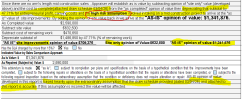
Heres a screen shot of where I'm at with this. What do you think? Also the post above this one with a question. I'm not sure if I'm using depreciating correctly... Couldnt think of a better word.
1773922623518.png
 
Looks good to me!
 
It is not a stab in the dark, (nor is it a precise fact ). It is a supported opinion that is credible because of market evidence - I agree we need to explain the decision (which might be that no discount is indicated ). Whatever our decision is, it should be market-based for the majority of cases - we've just covered that there can always be an outlier or exception.
Cost is market based. Cost to complete is market based. Estimated cost has to come from a credible market based cost source.
 
Last edited:
Cost is market based. Cost to complete is market based.
The "market " of what the components, or the whole costs differs at the wholesale/acquistion level and on the retail sell to consumer lefvel.

Same is true with properties ( though the underlying land being location based makes it more complex. ) But the same market competion on the sale end to customer buyers apply. That is why appraisal fundamental is that cost does not always equal value. The sales price of a dwelling might be less than, more than, or equivalent to the cost to build it ( and the same for a contributory cost of a component such as a swimming pool., )
 
Find a Real Estate Appraiser - Enter Zip Code

Copyright © 2000-, AppraisersForum.com, All Rights Reserved
AppraisersForum.com is proudly hosted by the folks at
AppraiserSites.com
Back
Top