
• Welcome to AppraisersForum.com, the premier online  community for the discussion of real estate appraisal. Register a free account to be able to post and unlock additional forums and features.

UAD 3.6

You have no idea what you are talking about.

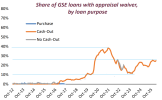
The charts that you posted do not show loan volume and the loan volume of refinances has sharply increased during 4q25 and 1q26......Thus, since waivers are much more prevalent on refinances than purchases, when refinance volume increases relative to purchase volume, the overall percentage of GSE loans with waivers naturally increases, which is exactly what has happened recently. This ain't rocket science, but apparently is above ability of some people to understand.

Alternatively, maybe this is all just a big conspiracy designed for no other purpose than screwing you and other appraisers.

Refinance volume has increased making up a larger share of total originations. You are saying that is why the total share of waiver usage has increased. That is part of it, but the data clearly shows that the waiver usage percentage on both RT and CO refinance is half way back to peak usage levels.

Just look at the chart. It's clear as day.
 
1780601422933.png


Let me clean it up for you since it seems to be too much information on one chart for you.

RT refinance waiver useage peaked in 2020-2021 at about 70%. Then bottomed in 2022-2023 at about 15%. Now it is back up to 50%. More than half way back to peak usage levels.
 
1780601632443.png

CO refinance peaked at about 40% in 2020-2021. It was down to about 10% in 2023. Now it is at 25%, half way back up to peak usage levels.
 
Refinance volume has increased making up a larger share of total originations. You are saying that is why the total share of waiver usage has increased. That is part of it, but the data clearly shows that the waiver usage percentage on both RT and CO refinance is half way back to peak usage levels.

Just look at the chart. It's clear as day.
It is really hard to fix stupid, but I will give it one last try.

Refinances have waiver usage that is far higher than waiver usage for purchases even though the percentage of refis with waivers currently is well below the peak of refi waiver usage a few years ago. Thus, when the percentage of loans that are refinances versus purchase increases significantly as has happened recently, then there is an increase in the overall percentage of GSE loans (this should be rather obvious).

If refinances still had the same (higher) level of waiver usage that they had at the peak right after COVID, the increase in overall GSE loans with a waiver would have been even higher, but that should be obvious to anyone with an IQ above single digits.
 
1780601794058.png

Purchase waiver usage is now around 17% and usage is at all time highs. It is ticking higher but not much higher than 2022.
 
It is really hard to fix stupid, but I will give it one last try.

Refinances have waiver usage that is far higher than waiver usage for purchases even though the percentage of refis with waivers currently is well below the peak of refi waiver usage a few years ago. Thus, when the percentage of loans that are refinances versus purchase increases significantly as has happened recently, then there is an increase in the overall percentage of GSE loans (this should be rather obvious).

If refinances still had the same (higher) level of waiver usage that they had at the peak right after COVID, the increase in overall GSE loans with a waiver would have been even higher, but that should be obvious to anyone with an IQ above single digits.

1780602250023.png

This is how everyone with normal to higher IQ interprets the data. It is right in the key points.

The recent rise in waiver usage us being driven primarily by higher waiver rates within each purpose.

Unbelievable.
 
View attachment 109604

Purchase waiver usage is now around 17% and usage is at all time highs. It is ticking higher but not much higher than 2022.
The charts you posted prove my previously made points. Appraisal waiver usage for purchases has been relatively flat since 2022, you even admitted it is not much higher than in 2022. However, the percentage of GSE loans with an appraisal waiver has increased significantly lately. If overall waiver usage has increased significantly lately, but waiver usage for purchases flat, then the increase in waiver usage must, by default, be due to refinances, no?

While refinance waiver usage is significantly below the peak in 2022, refi appraisal waiver usage is still far higher than it is for purchases. Thus, the recent increase in overall appraisal waiver usage is almost completely attributable to the recent increase in refinance originations.
 
The charts you posted prove my previously made points. Appraisal waiver usage for purchase, which you admit is not much higher than in 2022. However, the percentage of GSE loans with an appraisal waiver has increase significantly lately. If overall waiver usage has increased significantly lately, but waiver usage for purchases flat, then the increase in waiver usage must, by default, be due to refinances, no?

While refinance waiver usage is signficantly below the peak in 2022, refi appraisal waiver usage is still far higher than it is for purchases. Thus, the recent increase in overall appraisal waiver usage is almost completely attributable to the recent increase in refinance originations.

OMG. The MAIN REASON is because the PERCENTAGE of RT and CO refinance originations getting a waiver has TRIPLED since 2023.
 
Cash Out Refinance 10% -> 25%
Rate Term Refinance 15% -> 50%

The PERCENTAGE of waiver usage TRIPLED.
 
Per the data you provided, 84% of GSE valuations utilize an appraiser with 72% of valuations being a traditional appraisal and 12% being a hybrid appraisal....that aligns pretty closely with numbers I have been seeing.

I know that it stinks for appraisers who naturally want to keep ahold of as much business as possible, but, thus far, I have not seen any indication that loans with appraisal waivers or hybrid appraisals default at a higher rate than loans with traditional appraisals or that severity is any worse for defaulted loans with appraisal waivers or hybrids than for defaulted loans with traditional appraisals, thus there is no evidence that the use of waivers or hybrids have materially increased risk. As a mortgage insurer who is in first loss position on the loans and pools of loans that we insure, we constantly analyze everything that affects mortgage risk, so we would know if the use of waivers and hybrids was increasing risk.

There may come a point where the GSE's try to expand the use of waivers to an irresponsible level, and if that happens we will push back on them hard and could even decide to stop insuring some or all loans with an appraisal waiver (or increasing the premium on such loans), but we have not reached that point yet.
There hasn't been enough time to see. It takes a while for an over valuing (or under) to have an effect. The home has to be placed on the market for it to show. Or a new mortgage origination. But with the economy tanking and some areas shedding jobs like a golden retriever sheds fur, we may see the down side of the waivers sooner than anticipated. And never under estimate the ability of people to try and scam a system. This is just a variation of the old lending practices the helped cause the melt down.

It took only 10% of the actors in the mortgage industry to cause the 2007-2008 disaster. That's not very many. As waivers and 'alternative valuation products' become more prevalent, the risk increases. And like before, there is no mechanism in place to mitigate the risk.
 
Find a Real Estate Appraiser - Enter Zip Code

Copyright © 2000-, AppraisersForum.com, All Rights Reserved
AppraisersForum.com is proudly hosted by the folks at
AppraiserSites.com
Back
Top