IVCA aka Bert is heavy into his regression analysis. Don't know how accurate but he invested a lot of time and effort into his residential model.
If you come up with some obtuse analysis, it will legitimize your results.

I'll be honest, in a town of 33,000 people with stick built and manufactured homes, and lots of acreage properties with shops, barns, etc, a regression isn't always reliable. Once you do them enough, you can spot when there's either errors in the data used, or there's just too much variation for that property type for it to be reliable. I still do it anyway. If it's not reliable, I keep it in the workfile and use a depreciated cost basis and then modify using a sensitivity analysis. But other times, it DOES work.
For YEARS there were appraisers in my market who were still adjusting at $35/sf for GLA and $10,000/garage space, EVEN during COVID when prices were increasing like mad! By doing the regression, I saw that buyers were paying up to $98/sf GLA, $35,000 per bath and up to $40,000 per garage space! And when you look at the COST data, it made sense! Because a lot of times those building materials were 2X - 5X what they normally cost. And sales prices were reflecting that. Building a garage in most cases would cost MORE than the value indicated by the regression analysis. Those were an extreme... typically it was around $20K - $30K per bath and garage. But you get the idea.
But I also learned other important things. Like in my market... $/sf of GLA is a FAR BIGGER driver of price. Bedrooms ALWAYS had a high P value meaning they didn't drive market value. That is, unless you had a tiny home of 1-2 bedrooms, bedroom count never made a difference in 3+ bedroom homes. Because you could get alternate utility with the same square footage regardless of the # of bedrooms. But again, I only learned that because I did a ton of regression models on different property types.
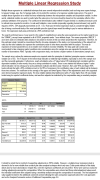
I also learned the regression supports market trends. In the above regression example, notice: days past sale was NEGATIVE. In other words... the older the sale (the larger # of days since the sale), the larger the negative adjustment, or the LOWER the sales price the further back you went. In other words... the regression also supported that the market was increasing on whatever time line I was using, whether 1 year, 2 years, etc.
Because I'm a nerd, I also played with other potential data set items... For instance: Was the study more accurate if I adjusted the sales price down for the concession before running the regression, or not? In lower priced homes... YES! It was! In other words... in lower priced homes, the concession did affect the sales price, more closely to a dollar for dollar adjustment. To back that up even further, I had 50+ sales contracts with counter offers saved that showed buyers and sellers adjusted sales prices exactly to account for the concession. But in higher priced homes, this was NOT the case! In higher priced homes, the concession was not an impacting factor in the sales price. Again, I might have instinctively thought that, but I couldn't prove it unless I ran the numbers.
I even used it to estimate the correct discount for an original location manufactured home vs. a non-original location. The VA will still loan on these non-original manufactured homes. Due to the low population of my area, I didn't always have only non-original location sales to use. Sometimes I had to use only 1 or 2 non-original location sales, and I had to use a few original location to compare with my subject which was a non-original location. Non original location manufactured homes, because it's been moved off it's foundation, won't qualify for a secondary market loan/typical loan, although it will qualify for VA if a lender is willing to loan on it in-house. So I had to figure out an adjustment for the original location sales. So, I used regression. I also did a separate study using median prices of original and non original which gave me a discount percent of around 19% for non-original location homes. And surprisingly enough, my regression supported that!
Regression is cool if you take the time to learn it, and you understand what the data is telling you. Again, it doesn't always work. But like anything else, it's a tool that can be used. I probably spent hundreds of hours running regression analyses. And doing so helped me REALLY understand my market! I'm not boasting here. I'm really just trying to say.... you can do some really cool stuff with regression models. It IS possible to use. And it doesn't have to cost an arm and a leg either. It DOES take some learning though. I started with the webinar that I linked above from the appraiser coach's website. From there, I watched youtube videos, I even contacted my old statistics teacher from my junior college who coached me through a few things I could try to make my models more accurate (he also happens to side hustle in real estate). It took me about 4 years to get really good at it. But it was worth it.