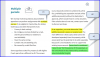
Denis D and I have had a conversation about this topic and have been emailing each other about. He gave me his thoughts and summarized them in an email to me the other day. I asked if I could share them here because it seems there is something for everyone in what he had to say. He told me I could but it's just in the context of
our personal conversation.
The summary is too long for a single post so I'll post the rest of it as soon as the minimal wait time has elapsed.
Definitely confusing (at least to me); glad you sent me the true copy!

Delete
dd multi lot graphic 1 newsletter.png
As I understand it…
#1: This establishes that multiple, legal parcels can be valued as a single subject if they meet the requirements bullet-pointed below. Ok.
#2: Poor choice of wording here. Better stated would be:
As an appraiser, you must determine if the additional parcel’s H&BU is for separate development, or as surplus land for the subject.
So, determine if this second parcel has its own H&BU for separate development or its H&BU is to act as surplus land to the subject. A simple example of a separate parcel acting as surplus land to the subject would be this: Imagine an improved property with a rectangular lot. Along the one side of the lot there was a 10’ easement for potential utility use. The utility use was never put to effect and the utility company sold that parcel to the subject’s owner. That parcel, individual and under with its own ownership separate from the subject’s parcel, cannot be independently developed. Likely, the H&BU of this parcel would be to act as surplus land to the primary parcel. In this case, the only other likely buyer would be the neighbor on the other side of the easement and it is very likely that it would act as surplus land to that neighbor as well. The value would be whatever contributory value surplus land has (most likely, the larger yard area this space creates).
Some may want to get very granular and evaluate how the separate lot’s tax assessments impact the value. For example, if this second parcel has additional assessments that apply to it because it is “separate” rather than part of the original, then the value may not be the same as if it were just a larger portion of the single lot.
In California, special assessments that are applied on a per-lot basis could add up and might wipe-out any additional value that was contributed by this second parcel (and, in theory, could be a negative value impact).
#3: Poor choice of wording here. Better stated would be:
If the second parcel’s H&BU is for separate development, then the valuation of that parcel would be similar to that of excess land. The contributory value of excess land is based on its value as-if it were separate, less any market reaction to the costs and risks involved in creating a separate parcel. In this case, the parcel is already separate; therefore subdivision costs would not be a factor; but other factors such as selling costs, holding costs, and risk-incentive can be part of the market reaction and would have to be accounted for.
I bolded “similar” because the process is very similar in both cases but not the exact same.
The client can define the subject anyway it wants to. In this case, the client (with good reason) is defining the subject as a primary and secondary parcel, with conditions the second parcel must meet if it is to be eligible for the loan. An appraiser faced with this assignment would first need to determine the eligibility. If it wasn’t eligible, the appraiser should notify the client (the client may want to still move forward… maybe they want to make the loan and keep it on their books?).
But assuming the second parcel meets the conditions, then the subject is defined as parcel 1 (improved, which I’ll call “primary”) and parcel 2 (“secondary). The value of that subject is a legitimate appraisal problem to solve.
As with any market value assignment, a fundamental question to be answered is, “what is the H&BU of the subject?”
In the above scenario, there are two possibilities:
1. The H&BU of the subject (primary and secondary parcels) is for them to act in tandem; the H&BU of the secondary parcel is as surplus to the primary. Therefore, the value of the second parcel is surplus land (with some potential adjustment due to tax consequences). This would be the easier path for this complex assignment.
2. The H&BU of the subject (primary and secondary) is to separate the secondary from the primary and develop the secondary to its separate H&BU. Its contributory value to the subject (as defined) is the value as-if separated, less the market reaction to separating it, etc., etc. Similar, but not exactly the same as excess land. This would be the more difficult path for this complex assignment.
The sticking point with the Fannie form is the way their form asks about Highest and Best Use
vs. what its selling guide states. The form asks this question:

Delete
dd multi lot graphic 2 form.png
I’m not going to repeat what the Selling Guide says here but the thrust of their concern is,
do the current improvements contribute value to the site such that they should not be demolished or renovated.
In the case where the second parcel acts as surplus land, the box can be checked “yes” without hesitation.
In the case where the second parcel should be developed separately, the improvements on the primary parcel, unless they should be demolished or renovated, would be retained. So the improvement stays and the use stays. What changes is the subject (2 separate parcels) should be separated and the secondary parcel be developed.