• Welcome to AppraisersForum.com, the premier online  community for the discussion of real estate appraisal. Register a free account to be able to post and unlock additional forums and features.

Converting Appraisal from Purchase to Refinance?

Status
Not open for further replies.
Thanks for any advice/input!

My advice is not to use this lender again.

The original assignment was for a purchase and the original appraisal was completed for that purpose. Requested and completed; no problem.

Lender delay forces your client to purchase the property for cash. At this point, it probably doesn't matter what the reasons were for the delays; it was delayed is what is significant.

So, now there is an appraisal for the purchase which wasn't needed.

Next, you ask the lender if the borrower can use the original appraisal for a cash-out refinance? This is a legitimate request and would (on the surface) seem to simplify things for all parties concerned.
The lender (rightly, in my opinion) says "we need to get an update to the original if we are going to use it for the cash-out transaction". The lender orders the update. So far, so good.

Now, what is an update? Factually, it is a new appraisal. As used, it is a process that relies on a prior appraisal and asks the question, "has the value declined since the last appraisal?"
If the value has declined, then most lenders will order a new, comprehensive appraisal (like the one that was completed for the purchase).
If the value has not declined, then most lenders will rely on the update (again, it is an appraisal but everyone uses the term "update") to make their lending decision.
This process is legitimate and makes good sense.

However, where your lender (again, in my opinion) is making its mistake is in requiring the original, purchase appraisal to be changed from what it was. That is not legitimate. That appraisal is set in stone for lack of a better term; it is correct for the lender to use the original report as a basis for an update, but it is incorrect for the lender to require the original appraisal to be changed and then use it as a basis for an update.
I can think of reasons why the lender would want the original to be changed; most of them are for processing reasons which makes it easier for their underwriting process but are not legitimate (my opinion).

Your lender can accept the update and the update can note that the update is for a cash-out refinance and go into all the details of the evolution of the assignment (started out as a purchase, was delayed, etc., etc.). What your lender cannot do is require the original report to be altered.
What your lender is trying to do is alter the original document to facilitate its underwriting purposes. This is not a legitimate or appropriate request. That's why I suggest you find another lender... but maybe you find that lender after this deal is complete.

My best suggestion is the same as others.... if this lender requires a 1004 (the typical appraisal- the kind you received for the purchase) to state that its purpose is for a refinance, then it will have to order a new appraisal. That lender may want to ask the original appraiser if he/she can discount the new assignment since the period between the last appraisal is so short, and while new analysis must be complete, the new appraisal (just as the update) can probably utilize much of what has already been completed.

In this scenario, your borrower (or the lender) should pay for
A. The original appraisal (full boat).
B. The update (full boat).
C. If the lender requires a new appraisal, then a new appraisal possibly at a reduced rate. The original appraiser, if he/she accepts the assignment, is under no obligation to reduce the rate; most appraisers I know (including myself) would probably offer a reduction. But, if I were extremely busy, I might not.


I appreciate you coming to this forum to ask appraisers for their opinion of this situation; I see it as doing research to assist your client (which is your role).
I've given you mine (others may differ); good luck in resolving the issue!
 
@ Denis ... thorough & professional opinion and appreciated. I do understand that the Lender can't request the original report be altered, but if they requested I order the Form 442 and the appraiser states it is now a refinance & notes the new owner of record (the borrower) which the appraiser agreed to do, then the Lender should have been able to accept it. I'm trying to do the right thing for my borrower, including eating fees and not passing on to her since bottom line I am the "lender" as far as she is concerned. Although I don't have access to the AMC and have to go through the Lender, I do have contact info for the appraiser listed on the appraisal, but would not contact them since it is barred under HVCC. I have to hope the Lender & AMC will be reasonable.
 
@ Denis ... thorough & professional opinion and appreciated. I do understand that the Lender can't request the original report be altered, but if they requested I order the Form 442 and the appraiser states it is now a refinance & notes the new owner of record (the borrower) which the appraiser agreed to do, then the Lender should have been able to accept it. I'm trying to do the right thing for my borrower, including eating fees and not passing on to her since bottom line I am the "lender" as far as she is concerned. Although I don't have access to the AMC and have to go through the Lender, I do have contact info for the appraiser listed on the appraisal, but would not contact them since it is barred under HVCC. I have to hope the Lender & AMC will be reasonable.

Appraisers are bound by a confidentiality requirement which restricts our ability to communicate with entities outside of our client (and, in this case, the lender and its agent, the AMC, is our client); additionally, it is likely that the appraiser, in his/her engagement agreement, is further restricted from talking to anyone on the origination side (which would include you). So, contacting the appraiser directly is probably not a good option (and, some appraisers take offense regardless of the intent of the contact, so I would not recommend that option).

Somewhere in this process, there has been a SNAFU. If it were on the appraiser's side I (and many others on this forum) would say so if that is what we think. In this case, I think it is definitely on the lender's side and possibly on the AMC's side; but there should be no distinction between the two: The lender and AMC should be considered as one entity as the lender engages the AMC to act as its agent.

I'd raise hell with the lender and tell them they don't know what they are doing.
You want the loan, they tell you what kind of valuation product they need, and you/your borrower pay for what they tell you. Then the come back and say it won't work because (a) they won't accept the update in its legitimate format, or (b) the appraiser refuses to alter the original report.
That's their problem; you've paid for what they request; try to get them to pay for what they now say they need, or advise your borrower to make a complaint to the Consumer Financial Protection Bureau (CFPB) alleging this lender is racking up unreasonable fees. That should get their attention.

If that fails, then it sounds like the only way to get the loan is to pay for another appraisal.

Thanks once more for coming to this forum asking for appraisers' opinions. I hope your client realizes you are doing your due diligence and looking out for their best interests and doing so in a professional and ethical manner. That's a good example for all of us!

Edit to add: I understand that you are "the lender" as far as the client is concerned and that you may end up eating the appraisal fee yourself. All the more reason to play as hardball as possible with the facility you are dealing with. I can tell you this; if you can apply enough pressure to the lender you are dealing with, they will either eat the appraisal fee or force their AMC to eat the fee. If they are unethical, they will try to get the appraiser to eat his/her fee, but it sounds like the appraiser is one who is willing to stand up for what is right. Good luck!
 
@ Terrel ... the Lender already did a desk review on the original appraisal and if they did so on the new one it would result the same as there were no issues as a result. The value being higher than the contract has no effect on the loan as the Lender will use the lower of the sales price she paid ... loan is $175,000 based on the $525,000 sales price, not the $554,000 appraised value ... I wouldn't expect a $50 fee, just not the full $405 on top of wasting $135 on the 442 that was requested, then rejected.

Compare it to the what the lender is cha chinging at the closing table. In fact, why not just compare it to your commission.
 
@ Joyce ... I work on .8 as I discount my fee working from a home office. This is a 34%ltv $175,000 loan, in trying to do the right thing for my client I am already making 35% of my discounted gross commission of $1,400 because I agreed to reimburse her on the HUD-1 $775 for 2 days moving storage she incurred for the delay and $135 for the Form 442. I'm going to end up reimbursing the new fee as well so I feel the Lender should work out a lesser fee since they were the ones that instructed me to order the Form 442 and now are asking for a Form 1004 basically wasting the $135 on the 442 as well as the further time delay. As it has only been 1 month since the original appraisal all that should need to be done is to change the purpose to refinance and the owner of record to the new owner/borrower, perhaps a re-inspection to make sure nothing was done to the home to negatively impact value. I just feel that with this being the case that it should be able to be done at somewhat of a reduced fee and believe that is a reasonable expectation rather than another $405.
 
If the original appraisal is only a month old then the appraisal could have been used by the lender no problem, NO 442, NO new appraisal, lenders can use any appraisal for the borrower, even if it wasn't completed for them as the client, that's totally okay.

The problem is lenders ALWAYS want their name on it for liability, if something happens with the loan they can't go after the appraisal because they are not the client. This is the screwed up thing, is that somewhere in all this mess appraisals went from being a document to make a lending decision, to a commodity to make money by lenders and AMC's and also as a document to have when a loan goes bad and they want someone to sue.

The ORIGINAL appraisal can be used by ANY lender to perform a lending decision, it DOESN'T matter who the original client or lender was. What amazes me is that more mortgage people and lenders just choose to ignore this or just simply don't know this, no one ever bothers to read the appraisal report as the STATEMENT OF ASSUMPTIONS AND LIMITING CONDITIONS section in the appraisal report CLEARLY states as follows.

21. The lender/client may disclose or distribute this appraisal report to: the borrower; another lender at the request of the borrower; the mortgagee or its successors and assigns; mortgage insurers; government sponsored enterprises; other secondary market participants; data collection or reporting services; professional appraisal organizations; any department, agency, or instrumentality of the United States; and any state, the District of Columbia, or other jurisdictions; without having to obtain the appraiser's or supervisory appraiser's (if applicable) consent. Such consent must be obtained before this appraisal report may be disclosed or distributed to any other party (including, but not limited to, the public through advertising, public relations, news, sales, or other media).

23. The borrower, another lender at the request of the borrower, the mortgagee or its successors and assigns, mortgage insurers, government sponsored enterprises, and other secondary market participants may rely on this appraisal report as part of any mortgage finance transaction that involves any one or more of these parties.

This is not in the pre-printed appraisal form just for the hell of it.:shrug:

So even if they want the "update" or "new appraisal" to have the borrower now listed as the current owner and it changed for a cash out and not a sale, it shouldn't matter, they can still us the original appraisal even if they are not the client, but I think we know why they won't or don't want to.
 
The original 1004 for purchase from the original owner to the borrower had ONE intended use, intended user (Lender) and effective date. Subsequently the Fee Simple Ownership in the Bundle of Rights changed. The first appraisal was done and must not be changed or "revised".

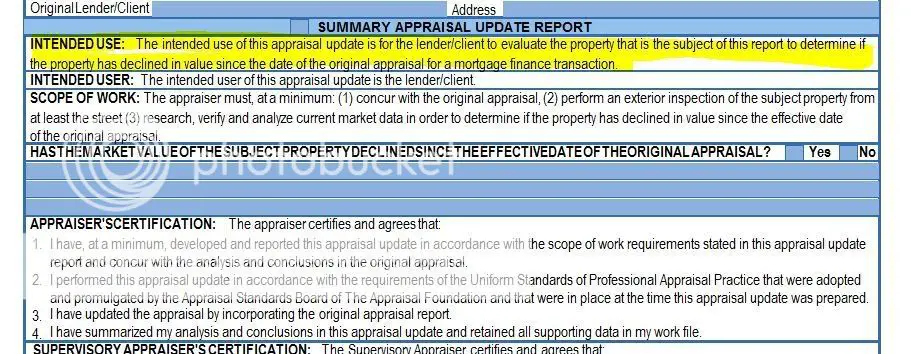
The 442 / 1004D report format's sole purpose is to report whether the market value opinion rendered in the original appraisal declined or not - same client, same intended use (same purchase loan), same owner, same borrower, original appraisal report incorporated (attached) OR referenced.

It is not appropriate to report a New Owner, New Effective Date, New Intended Use and/or a New Lender - on a 1004D.

New 1004 assignment:
While it may be possible to utilize the same comparable sales in the new assignment, it may NOT be as more recent, similar and/or proximate closed sales may have occured. Additionally, as the prior report analyzed and reported details of an existing Contract of Sale which was then consumated. It is no longer applicable to the cash-out refinance intended use for the NEW appraisal report.

The Lender screwed up by ordering the incorrect reporting format. The Appraiser is not responsible for that error.

OP appraisal problem is New Assignment with a new appraisal report including analysis of the confirmed prior sale which just occurred. The new report may, but is not required to, contain the original report's dwelling sketch as long as the prior inspection & sketch dates are reported, new subject interior and exterior photos and possibly new comparable photos and a new location map. The new report may, or may not, communicate the same market value opinion as the first completed report and assignment.

The New appraisal fee should reflect "time served" i.e. all the above elements of SR1 and 2 with possibly a slight discount for not having to physically re-measure the improvements plus a possible additional discount IF no more recent, similar, and proximate comparables which closed subsequent to the first appraisal occured. The applicable final fee invoice amount will be based on a business decision and reflect the actual time, expertise, and attendant effort required to produce the SECOND 1004 appraisal report.


Last edited:
The 442 (1004D for Fannie Mae/442 for Freddi Mac - same form) is not correct for what they want. The 442 used as an update just changes the date of value. The rest of the appraisal report it's "attached to" stays the same. The 442 is not a stand alone appraisal report. It relies on being attached to the original report or the understanding that the appraisers client has a copy of it.

What they need (what they are telling you) is an appraisal made for a refinance instead of a purchase. This is why they need a new 1004 report. Just deal with it. If the AMC uses the same appraiser he might offer a discount out of the kindness of his heart because there is a lot of things he doesn't have to do over again.

1004D.jpg


But in this day and age of AMCs swiping half of the appraisal fee don't expect any kind heartedness from appraisers. Before AMCs we'd probably do it for nothing or just a small fee as a matter of customer service. But those were the old days.
 
@ COB ... thanks & I am noting #23 to the lender
 
Status
Not open for further replies.
Find a Real Estate Appraiser - Enter Zip Code

Copyright © 2000-, AppraisersForum.com, All Rights Reserved
AppraisersForum.com is proudly hosted by the folks at
AppraiserSites.com
Back
Top