Or a transwoman running the 100Probably got more hormones than a bodybuilder contest

The Premier Online Community for Real Estate Appraisers!
-
Welcome to AppraisersForum.com, the premier online
 community for the discussion of real estate appraisal. Register a free account to be able to post and unlock additional forums and features.
You are using an out of date browser. It may not display this or other websites correctly.
You should upgrade or use an alternative browser.
You should upgrade or use an alternative browser.
Costco $4.99 chicken has preservatives
- Thread starter Fernando
- Start date
Yes butThe low-cost chicken is usually from genetically engineered breeding to force chickens to grow to butcher weight unnaturally fast - instead of giving a chicken a year to grow up over X months to a year, the hatcling swells to enormous size in 6-8 weeks and then is killed. Look it up online for details. The chickens are breast heavy cause that is more profitable, so much so that they can barely walk. The whole thing is anti-nature and disgusting. They feed it as cheap a feed as possible, so between growing too fast and poor nutrition, there is much less protein in the meat. Then it is frozen, shipped aorund and thawed to roast in heavy salt and preservatives. Yuck.


Surf Cat
Elite Member
- Joined
- Apr 21, 2003
- Professional Status
- Certified Residential Appraiser
- State
- California
In the girls division ...Or a transwoman running the 100
IMO Costco rotisserie chickens are good. When we get home, we basically debone it and package it up in glassware. We separate the dark meat and put that in plastic bags and give it to the neighborhood dogs who visit us. The doggies tug their owners over to our place because they're addicted to our treats.

In any divisionIn the girls division ...


- Joined
- Jan 15, 2002
- Professional Status
- Certified General Appraiser
- State
- California
Or a transwoman running the 100

- Joined
- Jan 15, 2002
- Professional Status
- Certified General Appraiser
- State
- California
Don't even get me started on PC Principal's defense of Caitlynn for being stunning and brave.

Terrel L. Shields
Elite Member
- Joined
- May 2, 2002
- Professional Status
- Certified General Appraiser
- State
- Arkansas
Maybe people can buy less junk food and spend a few more $ to buy organic chicken, whether cooked or raw.
No one left a chicken to grow a year to butcher, not even 100 years ago. My folks and grandparents (both sides) grew chicken from baby birds they bought as either eggs or baby chicks. You kept them 15 weeks. They weighted between 3 and 4 lb. typically. With better feed before anyone was experimenting with hormones, they still was kept 9 weeks or so when I was a child. If you kept them 10 weeks the feed bill got tremendous, no one would buy them and growers would lose money. They were too big and too tough for broilers. You had to bake them.The low-cost chicken is usually from genetically engineered breeding to force chickens to grow to butcher weight unnaturally fast - instead of giving a chicken a year to grow up
The additives at Costco are added when they process the bird, not by the farmer nor the chicken plant. This is a post-production process, so the birds don't rot or pass on pathogens. They also add water by soaking the birds and that's so they can sell you some water along with the meat USDA regulates that. Contrary to JG belief, there are no hormones added to chickens. They do add vitamins to the feed which is a mix of grains and alfalfa and other high proteins. Genetically, yes birds are bred to be bigger, faster and with larger breasts because breast meat sells higher and is what the consumer wants. For dark meat eaters like me it is a win-win. Thighs and legs are cheap. Wings used to be cheap then everyone found BBQ wings, and I don't buy that anymore because it is expensive.
From the early years after WWII, chickens were vaccinated against coccidiosis or they would lose up to 10% of the baby birds from this protozoon that is in their gut. And they were debeaked. Why? If you don't cut the top beak back about one-third, the birds cannibalize each other. A plucked feather or scratch will result in the other birds pecking that bird to the point of death.
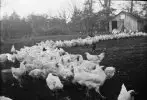
They now vaccinate in the hatchery and debeak before sending to the grower. Growers do not add any chemicals. As a Tyson's nutritionist pointed out, the genetics and feed means the birds are growing at their max rate. As for size, it's no different than a Shetland pony and a Frisian draft horse. Different genetics results in different size birds. And the feeds are very rich resulting in high growth rates so the meat of a 6 week old bird is softer than a 12 week "legacy' breed. And, so yes, you are basically eating a juvenile bird. The pix below is free range birds raised to 12-14 weeks to market in the early 50s.
Terrel L. Shields
Elite Member
- Joined
- May 2, 2002
- Professional Status
- Certified General Appraiser
- State
- Arkansas
There is no such thing as a "low cost" bird and the bird you raise organically is the same as one in a regular setting - exactly. No chemicals are added. And those "organic" birds are still vaccinated for coccidiosis
Organic chickens are generally vaccinated to protect against common poultry diseases that can cause significant health issues and economic losses. Vaccines used in organic farming are typically derived from natural or minimally processed sources and must be approved by organic certification bodies. These vaccines help reduce the need for antibiotics and other chemical treatments, which are limited or prohibited in organic management.