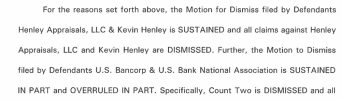
Was the appraiser cut loose on jurisdiction reason....
Nevertheless, to survive a Rule 12(b)(6) motion to dismiss, t
he complaint must contain "enough facts to state a claim to relief that is plausible on its face...a formulaic recitation of the elements of a cause of action will not do."
"Ferreting out the most likely reason for the defendants' actions is not appropriate at the pleadings stage."
This whitewashed appraisal, the fourth appraisal on the home in little more than a year, was completed in May 2023, by an independent appraiser, Clark Davis. Id. at PagelD #238, 347. This fourth appraisal came back with a valuation of $655,000. Id.[compared to $480k]
Plaintiffs do not allege, however, that Henley had anything to do with the decision process that U.S. Bank employed to ultimately determine the Turners' eligibility to refinance. While Defendants refute many of these allegations, at this stage the Court must view the facts in the light most favorable to Plaintiffs. Therefore, to decide the pending motions, the Court will consider both the appraisal process and the decision-making process to determine whether the claims against U.S. Bank may proceed, but the Court will only consider the events of the appraisal process itself in determining whether the claims against Henley may proceed.
The court recognized that plaintiff had alleged his membership in a protected class, and that his loan application was denied. He alleged that the denial was on account of the protected class membership. Id. at 505. Despite these allegations,
Judge Sutton, writing for the court, discussed how plaintiff's discrimination claims compared with the obvious alternate explanation: that the bank determined the loan was a poor business decision.
Plaintiffs made no significant improvements in their home in the interim, and although median home prices had increased, the movement from Defendant
Henley's appraisal of $470,000 to the Whitewashed Appraisal of $655,000 represented a 39.4% increase in value, which far exceeds the expected value increase on an annual basis in the Springboro housing market.
Plaintiffs allege that Henley's appraisal was unlawfully discriminatory. Specifically, they allege that Henley knew that they were members of protected classes because of personal interactions.
In his response, Henley challenges the contention that he ever interacted with the Turners or had any knowledge of their membership in protected classes. Doc. #28, PagelD #536. He also states that his appraisal was conducted in accordance with his licensure and experience and adhered to uniform appraisal standards.
A
dditionally, while the Henley appraisal resulted in a valuation $185,000 lower than the one conducted a year later, it was only $15,000 lower than the second appraisal and $50,000 lower than the first appraisal conducted by a different bank. Although Plaintiffs conclude that this must mean that the valuation is unreasonable, they lack sufficient factual allegations to adequately plead this claim. Plaintiffs here include no such allegations about similarly situated homeowners who were also appraised by Henley. While there is no requirement that Plaintiffs must provide allegations that detail disparate impact or direct evidence of the discrimination, the Court is not required to blindly ignore the obvious alternative theory: that Henley honestly thought the property was worth the amount that he appraised it for. See supra note 3. Merely stating that Henley discriminated against the Turners, is insufficient as a matter of law under Rule 8(a).
They allege that Henley claimed to be providing a nondiscriminatory appraisal and, as the appraisal was in fact discriminatory, this representation was false. Id. This claim, however, relies on the allegation that the appraisal is indeed discriminatory. As explained above, Plaintiffs have failed to make this requisite allegation and thus the claim that Henley misrepresented his actions must also fail as a matter of law.
Likewise, t
he claim of negligent hiring, training, and supervision against Henley depends on the underlying allegations of discrimination. Without the factual foundation for these allegations, this claim also fails.


 community for the discussion of real estate appraisal. Register a free account to be able to post and unlock additional forums and features.