• Welcome to AppraisersForum.com, the premier online  community for the discussion of real estate appraisal. Register a free account to be able to post and unlock additional forums and features.

Fee Simple vs. Leased Fee Interest

Status
Not open for further replies.

runner52

Sophomore Member
Joined
Mar 15, 2010
Professional Status
Certified General Appraiser
State
Washington
Not quite sure if I'm appraising Fee Simple or Leased Fee. Waiting for client but thought I'd bounce it off in the forum.
The subject was built for owner user - single tenant medical office.
In recent years he started leasing a few offices and exam rooms out to a couple of other medical providers. The rents are ridiculously above market and the leases are expiring in 2021 and 2022.
The property is pending sale and will be purchased by a dentist. The client thinks the dentist will occupy most of the building and possibly lease out some spaces - whether to existing tenants or not is unknown.
The floor layout is such that I have decided to take the 6,000 SF total space and assign a market rate to the whole square footage. Really would be the same regardless if I did that or assign the same rent to each space. The layout and finishes are the same and there would be no reason to assign different rates to the different spaces. And as I mentioned, the building was a single tenant medical office for years.
Typically I would not ignore the leases in place and would automatically say "Leased Fee" but if the buyer is buying for owner occupancy with some chance but not definite - of leasing some space, is it still "Leased Fee"?
 
I would bet you are being asked to value the fee simple. The rents are not part of the property ownership. And in my experience medical space brings a huge premium over "normal" office space.
 
And I would guess that the rented spaces are not delineated from the remainder, so there is likely some use of the owner-occupied space utilized by the tenants....lobby, bathrooms, maybe even receptionist. That would explain all or some of the high rents.
 
If you are doing leased fee, you will do contract rents in your income cap approach. If you are doing fee simple, you will apply market rents in your income cap approach.

It can make a huge difference in your income cap approach. You have to decide what the client wants. Your cap rate will also be important but not so much on short term leases that you revealed.

One huge question I would have is to the buyer. I would want to talk to buyer or their agent about their plans. It could have an impact on your rent estimates whether leased fee or fee simple.

Okay, your locked for a short term on current leases. So think about it. Put it all together. You need to know buyer's expectations and plans. The buyer probably had to present a pro forma to the bank. I would want that also.
 
Last edited:
I have slept and I have a little oxygen in my brain now. Leased fee vs fee simple could be different and since you have existing leases, you need to do qualitative analysis in final reconciliation.

Market value definition is important in your development. So just reconcile in final reconciliation. Leased fee and Fee simple could be equal or slightly off.

That is what rings in my ears is you are concerned leased fee is higher than fee simple. Talk to buyer or buyer's agent.

I would require copies of exiting leases. I would want pro forma from buyer. Require your client to send you the pro forma from the buyer or you get it from buyer.
 
Technically it is still leased fee as the building is encumbered by a lease. I have called a building leased fee in my report, which is technically correct, then analyzed it as fee simple and explained why I did it. You might say something to the effect that the building is considered leased fee with the prospective owner planning on occupying the majority of the building. I determined the leases to be above market with the final opinion of value based on prospective market rents. An investor will not pay significantly more for a short term above market lease as the risk of that lease decreasing in the near future negates any premium an investor might consider paying.
 
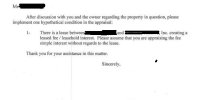
Included below is a snip from a letter sent to me by an attorney regarding a piece of farm ground I was appraising.

Personally, I believe this is the correct way to appraise real estate encumbered by a lease(s) if you want to appraise the fee simple. Otherwise, the interest appraised is the leased fee.

1633097653591.jpeg
 
Last edited:
Technically it is still leased fee as the building is encumbered by a lease. I have called a building leased fee in my report, which is technically correct, then analyzed it as fee simple and explained why I did it. You might say something to the effect that the building is considered leased fee with the prospective owner planning on occupying the majority of the building. I determined the leases to be above market with the final opinion of value based on prospective market rents. An investor will not pay significantly more for a short term above market lease as the risk of that lease decreasing in the near future negates any premium an investor might consider paying.
And he or she needs to make sure his lease comparables are apples to apples. I agree.

And the buyer may already have leases in place or on the horizon. That's huge also.
 
Technically you are correct unless your opinion is market value of fee simple vs leased fee. Big difference. Definition of value is huge. Property interests being apppraised is huge ( leased fee or fee simple). So, Just because property is encumbered by a lease(s) does not mean there is not a leasehold interest also. Be careful with it. If you do fee simple, apply market rents. If you do leased fee, apply contract rents.

Okay, remember income cap approach is only one approach. Just get it right. Your final reconciliation may solve things. Do other approaches. We used to do all three approaches on every commercial. Every time.

The boss said do it. I said okay. Things balance out with all three approaches. Even if you have a wide range, you can give a credible opinion in the range.
 
Last edited:
Curious. How big in GBA is this building? What surrounds it? I really don't care. Tell me what buyer tells you.

Your H&B use analysis needs to be based on what buyer is telling you to some degree. That's where all 3 approaches help.
 
Last edited:
Status
Not open for further replies.
Find a Real Estate Appraiser - Enter Zip Code

Copyright © 2000-, AppraisersForum.com, All Rights Reserved
AppraisersForum.com is proudly hosted by the folks at
AppraiserSites.com
Back
Top