
• Welcome to AppraisersForum.com, the premier online  community for the discussion of real estate appraisal. Register a free account to be able to post and unlock additional forums and features.

Regression Analysis

Status
Not open for further replies.
I ran a set of data that illustrates your point. I did a single regression, haven't figured out multiple regression with it yet.
Multi regression is where the true rocket science begins - learning to produce a statistically significant AND internally cohesive model requires far more than just learning how to set up our software and data-mining. It is way over the head of most appraisers. I'm not the sharpest pencil in most rooms, but I spent considerable time and effort trying to make it work in an extremely homogeneous area San Diegian's will recognize: mid-1980s Mira Mesa. This was about 30 years ago when everything was still fairly new without a lot of variance between homes, and I could find excellent 100+ samples within a year or so, with the same room count if not the same plan. It was a nearly perfect environment for a Master's Thesis and nobody was doing it - also, I was in "love with the process" back then (not married). Excel tools haven't changed much, actually, since then either. My r-square was always above 90% and it compelled me to start the econometrics masters at SDSU I mentioned earlier.

The problem was that darned heteroscasticity lol. Even if I could correct for auto-correlation and all the other stuff I've forgotten, the predictive ability of my models broke down and, while close, I could tell my forecasts were not good enough to really nail values consistently. In short, at the time nobody was going to hire me FOR this process, and I realized nobody was going to keep hiring me after I killed several deals with it (which I confirmed I would have been in error). I also tried but failed to reach any meaningful (and repeatable) confidence levels in more heterogeneous neighborhoods since they required a greater number of variables (i.e. room counts). In short, I had to do the adjustment grid anyway.

Well, I met a lot of girls at SDSU of course, and being only a couple of years older and a fit USMC reservist with his own business I was pretty much in trouble after the first month. For the practical hours I spent trying to make the data match the textbooks I gained a lot of insight but preferred all of the other things San Diego had to offer: girls, Mexico, surfing, boating, fishing, and nearby deserts, mountains and of course bars. Eventually, the endorphin rush of briefly seeing 3D data in a 4th dimension lost out to other kinds of endorphin rushes.

Their modeling may be more mainstream but has't improved much today - I live in a homogeneous neighborhood with just a few variables to worry about and the models they run for refinance screening can't seem to account for our larger lot with afternoon-shade on a lake compared to a postage size fenced lot with the sun scorching their rear patios across the street. Actually, they could but it would take somebody paid more than the appraiser to customize the model they're using, and since the whole idea is time and cost-savings they'd rather short the loan amount. Why they keep hiring THAT program over an appraiser doesn't really add-up, does it?
 
In my opinion the benefits of the information age to residential real estate valuation is not analytics. The explosion of data and accessibility of the data allows the appraiser to better identify the differences that impact value <SNIP> Analytics is not the best way to take advantage of all the information available today.
Bingo - last word, close the thread.
 
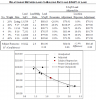
Also, we have to understand that predictive statistics - which is what we've been discussing here for the most part - is much less credible in real estate analysis than descriptive statistics. You can roll out a model that shows a relationship between variables as a predictor of value, but don't confuse this with point-estimation of value. Most of the AI education is pretty good at this but somehow they go a little too far giving appraisers the confidence to use statistics to predict (forecast) a point estimate rather than just say that the relationship between X, Y and Z is this and thus supportive of my adjustment or conclusion - which should be HOW it's used. Show the DATA and do the WORK before conveying your CONCLUSION, and then back it up with statistics; don't believe that statistics is giving you the conclusion. Here's an example - a simple linear regression formula between $/SqFt of land and land-to-building ratio, showing the results, and adding an exponential or power trend line. I am completely confident explaining that this illustrates a RELATIONSHIP and shows that my CONCLUSION is not unreasonable. I don't try to defend the statistics, and the point-estimates are simply not credible alone.

By the way, these seem to always work out even with the large economic adjustments you see in this one (don't judge me for using 1 & 2 since there were other reasons I explain why they are reasonable and credible). I don't modify the adjustments so that the charts work, they just do with certain property types and under certain conditions.
upload_2017-5-22_9-38-40.png
 
Appraisers should not be fooled by randomness nor math. We are providing SUPPORT for out opinions via a logical and "doable" path. So the math is not meant as a rigorous answer to a formula. If a MLR or sensitivity exercise SUPPORTS our value then it says we have a basis for making the judgment. It does not mean that this is the only answer. I know some argue that Std. 1 basically isn't allowing the appraiser to make judgments about anything...the answer must be rock solid math. That is not my interpretation of Std. 1. 1-4 which says you "collect, verify, and analyze all information necessary..." and it says, despite eliminating the "summary" report that one "summarize the information analyzed..." So? Joshua Walitt (SRA) described the 4 most common errors in the Summer 2017 issue of Working RE. I have little quarrel with his analysis of the situation other than to argue that there is an alternative way of thinking about some things.

He says lenders are allowed to request you to "provide additional support and clarification regarding your adjustments." Great. I guess I missed that part in USPAP. At least it is not explicit. Rather USPAP beats around the bush by saying the client and intended users must understand the rationale for the opinions and conclusions... We've had recent threads where folks argue that they feel impelled to appraise the comps, (and thus appraise the comps comps???) At some point one has to draw the line. No one has explained to me how one writes an estate report that a six year old heir (a stated intended user) can understand what you are saying...I suppose Crayola and a Big Chief tablet and very simple words...sure they should have a guardian but what about that 18 year old? Or an enfeebled person attempting to get Medicaid. We guess about who is an "intended user" - a term obviously coined for the banking industry alone? That standard isn't practical but we pretend it is and go through some arm-waving procedures to satisfy regulators, and all because something that was written for the lending community...which is why appraisers who are working outside of the lending community scratch their heads sometimes.

The implication of Walitt's article is that what we are supposed to be autotrons and produce AVM-like conclusions with certitude and every iota of information we use, parse, or express must go into the report based on that Std 2-2 admonishment to "summarize the information". The truth is that I can parse a sale with $45 per SF adjustment and make adjustments for other items and come out the same answer as someone who is lump summing those adjustments and making a $60/SF adjustment. The data can "support" what either of us do. Often this support can be flawed but not obvious...the lender is happy as a pig in mud with your "support" yet it means little.

I see comments in the forum occasionally about making $200/SF adjustments in areas where building costs are $150/SF...clearly the adjustment is capturing more than building costs, rather is capturing the land contribution. I linked the Voice of Appraisal elsewhere. https://appraisersforum.com/forums/threads/crawford-voice-of-appraisal.216808/

Very carefully listen to Ross Kay's comments regarding the price. It applies in Canada but applies here as well. You are not buying the house. You are buying the land and the rights to occupy that land. So rapid increases in prices are a reflection of the change in the value of the land, not the value of the house because the cost to construct the house is changing much slower than these bubble prices (see what the Canadian market is doing now.)

So I see the notion that we have to have MLR or Sensitivity or paired sales in every report as nonsensical yet "required" more by tradition than by USPAP. Why can't it be in our files? Saying that you must "summarize" everything, is therefore saying your workfile should look like the old "self-contained" report.
 
In short, at the time nobody was going to hire me FOR this process, and I realized nobody was going to keep hiring me after I killed several deals with it (which I confirmed I would have been in error).
Actually, they could but it would take somebody paid more than the appraiser to customize the model they're using, and since the whole idea is time and cost-savings they'd rather short the loan amount. Why they keep hiring THAT program over an appraiser doesn't really add-up, does it?

Yup, that is the crux of my posting my model, above. It took 30 to 40 hours of work, drove the comps too. It wasn't better than what a traditional appraisal could accomplish. The important lesson learned from the MRA modeled above {IF using the correct homogeneous comp set} is that 98% of the value was explained, in this case, by 2 variables! This is a key understanding that brokers and appraisers should learn -- minute things like what paint color (within reason) used for staging or the direction a porch faces, or tile versus vinyl kitchen floor were immaterial. Some properties may need 3, 4, or 5 variables, but the K.I.S.S. principle remains.

folks argue that they feel impelled to appraise the comps
Commonly, commercial building's square footage is off. I've wanted to drag a tape around a few comps, but draw the line at trespassing. Yet the buyer/seller/broker used the Assessor's wrong square footage. (If my measurement is different than the Assessor, I'm supposed to use my measurement, but the marketplace uses the Assessor. There is no guidance or liability protection in this regard. Meanwhile, the emphasis of confirmation is all about the sale price, which I don't find, in my market, to be false or different than what CoStar or the Deed Stamps show.

The implication of Walitt's article is that what we are supposed to be autotrons and produce AVM-like conclusions with certitude and every iota of information we use, parse, or express must go into the report based on that Std 2-2 admonishment to "summarize the information".
Multiple-regression analysis only compounds the clarity, because NO time is placed on researching the multitude of data, where traditional appraisal has the opportunity, taken or not, to better research a handful of comps. Nevertheless, much of sale price is "Unknown Knowns", like interior quality/condition, various capital repairs, or defects not disclosed on an MLS or by an interview.

Saying that you must "summarize" everything, is therefore saying your workfile should look like the old "self-contained" report.
And my competitors have 2 week turn-around times for a commercial building. Hearsay tells me that one big firm limits inspection time to 1 hour. It is a tenuous profession, littered with hypocrisy.

The data can "support" what either of us do. Often this support can be flawed but not obvious...the lender is happy as a pig in mud with your "support" yet it means little.
While I would be happy to explain and defend my model, above, to a judge, there is no way I'd want to share it with a lender, mortgage under-writer, or borrower. The judge would attempt to understand and appreciate what it did, didn't, could, and couldn't. The intellect and the motives of the lending community would make it a nightmare.
 
Last edited:
He says lenders are allowed to request you to "provide additional support and clarification regarding your adjustments." Great. I guess I missed that part in USPAP.

That is from D-F, not USPAP :)

I was listening to a speaker on this topic a couple of weeks ago, and he asserted that one of the biggest lies in appraising is the standard statement found in many reports that the adjustments were all base don paired sales. :) Many have wised up to the fact that there are appraisers who actually have no support for their adjustments and are just working from lists.

As for regression itself, most of the "push" I have seen for the use of regression has been from companies that sell regression solutions and/or seminars, not from clients/lenders.
 
That is from D-F, not USPAP :)

I was listening to a speaker on this topic a couple of weeks ago, and he asserted that one of the biggest lies in appraising is the standard statement found in many reports that the adjustments were all base don paired sales. :) Many have wised up to the fact that there are appraisers who actually have no support for their adjustments and are just working from lists..
That is certainly not news to a lot of people.
 
That is from D-F, not USPAP :)

I was listening to a speaker on this topic a couple of weeks ago, and he asserted that one of the biggest lies in appraising is the standard statement found in many reports that the adjustments were all base don paired sales. :) Many have wised up to the fact that there are appraisers who actually have no support for their adjustments and are just working from lists.
I am looking at an appraisal right now of a 988 sf home with a contract price of $412,000 in which the comps range in size from 1,756 sf - 3,014 sf and the GLA adjustment is $10/sf, which the appraiser claims was derived from paired sales analysis....that does not even pass the laugh test.
 
the standard statement found in many reports that the adjustments were all base don paired sales
(sic)
which was Walitt's argument. I cannot disagree that such boilerplate language conveys little, but if one said the "support is held in my files as paired sales and is available for inspection upon request" be a violation of USPAP? Or just another secondary market stip? And so as many of us are not going to reinvent the wheel, these items may be dated but applicable. I run a big set of paired sales from 2014-2016 and I get zinged for not having it up to the last available sale? Probably. Even though you can bet there isn't sufficient change to justify worrying about it.
much of sale price is "Unknown Knowns", like interior quality/condition, various capital repairs, or defects not disclosed on an MLS or by an interview
exactly... we cannot quantify those qualities precisely.
the motives of the lending community would make it a nightmare.
That is why "real" appraising and "bank" appraising has diverged over the decades...
the "push" I have seen for the use of regression has been from companies
I use regression far more to educate myself than to use as evidence for adjustments. Using regression, I see what is driving value, and as pointed out by Leased Fee, often it is very few factors that are clearly impacting the subject values
 
I was listening to a speaker on this topic a couple of weeks ago, and he asserted that one of the biggest lies in appraising is the standard statement found in many reports that the adjustments were all base don paired sales. :) Many have wised up to the fact that there are appraisers who actually have no support for their adjustments and are just working from lists.
.

That is certainly not news to a lot of people.

Why do appraisals continue to be assigned to those appraisers?

Assigning 10% of assignments in the market area to a appraiser like Denis and letting him do his thing with a very large local firm is better than AMC model of ordering from hundreds of cheaper and faster people and then trying to micromanage their appraisal reports.
 
Status
Not open for further replies.
Find a Real Estate Appraiser - Enter Zip Code

Copyright © 2000-, AppraisersForum.com, All Rights Reserved
AppraisersForum.com is proudly hosted by the folks at
AppraiserSites.com
Back
Top