• Welcome to AppraisersForum.com, the premier online  community for the discussion of real estate appraisal. Register a free account to be able to post and unlock additional forums and features.

The New USPAP

Status
Not open for further replies.
And since you keep sniveling about inspections, it isn't even possible for an appraisal standard covering all types of assignments and all types of properties to require personal inspection by the appraiser. Proposed construction and retrospectives involving properties that have since changed of been demolished being just 2 examples of physically impossible. Drive-bys with no legal onsite access being another. It isn't USPAP which created the limitation; it's the real world conditions for various types of assignments.

If an acceptable appraisal or appraisal review (take note of yet another example) can be rendered under one inspection-related scenario then that proves it can be done under other scenarios.
 
That's an extremely superficial statement and also largely incorrect.


Measurements are never 100% accurate. It is a question of degree. One of the many flaws of USPAP is that it never answers the question: When is a measurement better than no measurement at all? That is a VERY good question that no one has answered. Douglass Hubbard would take a very loose approach here: Even rough approximations are better than none - and his whole methodology is based around that. And he has many followers, including the military.


He may indeed be the one who made the error. What difference does that make. It goes back to the previous issue. In other words, Appraisers should be able to use approximations if that is the best they can do and it is "good enough". -- But, again, what is good enough?


That's very crazy. We assume rather that that is the best information available and it helps rather than hinders the appraisal process.


Yes.

For example I have a very useful comparable, but the GLA is missing in the MLS. I can however go to Earth.Google.com and estimate the GLA roughly from the approximate dimensions using the Google measure tool. Is that good enough? Is it misleading? See --- you cannot answer the question, can you? You don't have a clue. Neither does USPAP.

Dumbos.


Does USPAP give us a standard for when to trust a source of information? A solid standard or protocol that works in this hybrid case. I don't think so.


100% happens with respect to some logical statements like "Did you see a house or property X when you visited it, Yes or No?" But your answer to the question: "What is the GLA of the house location on Property X?" can never be 100% perfect because measurements cannot be 100% perfect. USPAP does not define this ****. The GSEs via ANSI give us a standard for length measurements that is within one inch or 1/10 of a foot, with exceptions allowed. That's not bad. For those exceptions it is implicitly: "Do the best you can." But there is no standard for the accuracy of the computed GLA - which must take into consideration exclusion of certain areas. So even here, with the exemplary standard, long-time coming, we do not have 100% accuracy. Don't downplay this problem, btw. Because when it comes to regression on 100+ properties, we have to live with missing information and approximations of some properties under the "best we can do." premise. --- And thereby skirt the fact the USPAP has nothing to say about these issues.


In many cases, I am sure for the wrong reasons.

You should always have some engineers and scientists involved in standards, who are also somewhat familiar with the subject matter of appraisal.


**Excellent point points, Bert ** Even (AVMs) have standards for evaluating the accuracy of a model for different property types using **objective methodologies**. While these standards are voluntary, they at least provide a benchmark for evaluation. However, (USPAP)does not offer specific guidance on evaluating accuracy for different property types. This lack of clarity can lead to confusion and challenges for appraisers and state boards when interpreting and applying USPAP standards. That’s why appraisers are easy fodder for the charlatans suing for so-called racial discrimination and so on. TAF and USPAP have failed miserably and need to be replaced.
 
Appraisals are compared to actual prices all the time, some comparisons occurring prior to a sale and others occurring after. Meanwhile, most users don't value the RA and related enhancements to appraisals to pay one dime extra in the fees. The enhancements are effectively unmarketable. The realities of the market is one reason both of you are so opposed to the current setup. You're having problems selling what you want to sell to them instead of having to settle for what they're willing to buy. (as in, what they consider to be sufficient to their usage)
 
Last edited:
Sorry, I want to be 100% clear on what you mean, and I am not.

In the case cited (500 SF error in reported GLA), do you think that report would violate SR 2-1(a) or not?

STANDARDS RULE 2-1, GENERAL REPORTING REQUIREMENTS
Each written or oral real property appraisal report must:
(a) clearly and accurately set forth the appraisal in a manner that will not be misleading;
In your example, you were very clear that the error of 500sf was because an appraiser relied upon past measurement information, which was not current and didn't include an addition. The appraiser, in your scenario, did not measure the home upon his new inspection, and the subsequent report's opinion of value is simply inaccurate because the home's size was portrayed as being smaller in his appraisal.

The error was not caused by a malfunction in equipment, nor was he relying upon third party information in your example.

SR 1-1(b) states the appraiser must not commit a substantial error of omission or commission that significantly affects an appraisal...... Goes on to discuss the required care in avoiding errors that would significantly affect conclusions. Discusses the diligence required, including identification and analysis of factors, conditions, data, and other information impacting credibility of the assignment results.

SR 2-1(b) states the appraisal report must clearly and accurately set forth the appraisal in a manner that will not be misleading.

In the prior USPAP definitions page, "Misleading" was specifically defined as: "Intentionally or unintentionally misrepresenting, misstating, or concealing relevant facts or conclusions."

If you are asking if the failure of measuring a home in a new assignment, and utilizing prior information and presenting it as current, doesn't fall into the definition shown above, then I suppose we have different angles on the law.

One would say, the lack of a new measurement and using prior data as current is just a simple innocent error. Last I checked, an innocent error is synonymous with unintentionally misrepresenting or misstating facts, and I'm sure would be called misleading by those looking at the letter of the law based on the prior version definitions.

Is it a USPAP violation you asked? If that appraisal was used in court or reviewed by the commission due to a complaint from the seller, who lost money on the sale of his property because of that error, I suspect misleading would be the angle of argument. Don't you agree? (Did you just nod your head in agreement?)

 
Last edited:
In the example you're citing, if the (appraiser personally made an error) was already prohibited elsewhere in SR1 then the "misleading" definition doesn't add anything to that prohibition. "manner that is not misleading" speaks not only to the facts of the matter but also the appraiser's actions and intent on the reporting side.

The cert already qualifies "to the best of my knowledge and belief", which actually contradicts the idea that making an unintentional mistake is a violation of the ETHICS RULE. The *appraiser's* error is the error all by itself. Whereas that definition can be interpreted to apply to other errors that the appraiser didn't intend and didn't make.
 
Appraisals are compared to actual prices all the time, some comparisons occurring prior to a sale and others occurring after. Meanwhile, most users don't value the RA and related enhancements to appraisals to pay one dime extra in the fees. The enhancements are effectively unmarketable. The realities of the market is one reason both of you are so opposed to the current setup. You're having problems selling what you want to sell to them instead of having to settle for what they're willing to buy. (as in, what they consider to be sufficient to their usage)

the unethical stakeholders prefer appraisal products that dont follow USPAP, eh DW?:shrug: :rof: :rof: :rof:
 
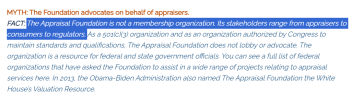
FYI

TAF's stakeholders include appraisers and regulators, not just the "consumers".

1708719192693.png
 
Last edited:
In the example you're citing, if the (appraiser personally made an error) was already prohibited elsewhere in SR1 then the "misleading" definition doesn't add anything to that prohibition. "manner that is not misleading" speaks not only to the facts of the matter but also the appraiser's actions and intent on the reporting side.

The cert already qualifies "to the best of my knowledge and belief", which actually contradicts the idea that making an unintentional mistake is a violation of the ETHICS RULE. The *appraiser's* error is the error all by itself. Whereas that definition can be interpreted to apply to other errors that the appraiser didn't intend and didn't make.
So - You believe the answer to DW's question is "Yes".....
 
The appraiser made a competency error and conveyed it in their report. They didn't make an unethical attempt to mislead.

If you make a typo in a report, it's an error but it isn't an attempt to mislead.

2-1.a "clearly and accurately" is already required.

Maybe the ASB should reword to "meaningful, clear and accurate to intended users" if that's what they mean. Given the extent to which people already conflate "accurate results" with "reasonable opinions" that's not going to be an easy sell.

Saying all inaccuracies mislead the reader, even when accidentally , is going to give people the wrong idea of what the appraiser is trying to do. For one thing, we disclose a bunch of assumptions and limitations precisely BECAUSE we are aware of our limitations WRT "accurate".
 
Last edited:
In your example, you were very clear that the error of 500sf was because an appraiser relied upon past measurement information, which was not current and didn't include an addition. The appraiser, in your scenario, did not measure the home upon his new inspection, and the subsequent report's opinion of value is simply inaccurate because the home's size was portrayed as being smaller in his appraisal.

The error was not caused by a malfunction in equipment, nor was he relying upon third party information in your example.

SR 1-1(b) states the appraiser must not commit a substantial error of omission or commission that significantly affects an appraisal...... Goes on to discuss the required care in avoiding errors that would significantly affect conclusions. Discusses the diligence required, including identification and analysis of factors, conditions, data, and other information impacting credibility of the assignment results.

SR 2-1(b) states the appraisal report must clearly and accurately set forth the appraisal in a manner that will not be misleading.

In the prior USPAP definitions page, "Misleading" was specifically defined as: "Intentionally or unintentionally misrepresenting, misstating, or concealing relevant facts or conclusions."

If you are asking if the failure of measuring a home in a new assignment, and utilizing prior information and presenting it as current, doesn't fall into the definition shown above, then I suppose we have different angles on the law.

One would say, the lack of a new measurement and using prior data as current is just a simple innocent error. Last I checked, an innocent error is synonymous with unintentionally misrepresenting or misstating facts, and I'm sure would be called misleading by those looking at the letter of the law based on the prior version definitions.

Is it a USPAP violation you asked? If that appraisal was used in court or reviewed by the commission due to a complaint from the seller, who lost money on the sale of his property because of that error, I suspect misleading would be the angle of argument. Don't you agree? (Did you just nod your head in agreement?)
I never said he relied on past measurements. I never said he did not actually measure. I said he made a cloning error.

The appraiser fully inspected and measured the home. But when he started the report he cloned a prior report and did not change the sketch. He had a field sketch with current and correct measurements, but he sent the report out with the sketch from the report that he cloned - which was just similar enough that it was difficult for the lender to detect the error.

So, the issue has nothing to do with a failure to measure or assuming that prior information was still current.

In simple terms, the information presented in the report was not accurate.

I do not have to speculate how the state board handled it. As I said, it is an actual case.

He was turned into the state as the result of mandatory reporting law.

The state found that he had violated 2-1(a), because the report was misleading because it was not clear and accurate.
He was not cited for violating the ETHINCS RULE because he did not knowingly prepare a misleading report. The report was misleading, but not on purpose. That is the rub - some think it has to be on purpose to be misleading.
 
Status
Not open for further replies.
Find a Real Estate Appraiser - Enter Zip Code

Copyright © 2000-, AppraisersForum.com, All Rights Reserved
AppraisersForum.com is proudly hosted by the folks at
AppraiserSites.com
Back
Top