• Welcome to AppraisersForum.com, the premier online  community for the discussion of real estate appraisal. Register a free account to be able to post and unlock additional forums and features.

3.6 Crunch Time

Not trying to be nasty....just floored that you apparently have no idea.

Or you do, and want to debate....for debate's sake, which I do not have time for, since it is not a simple question - it is the question people are supposed to have answered for themselves after spending 2 years or more with a mentor, studying appraisal methodology to get competence, and, for regulated work, be licensed.
So you really don't know. That's ok. Lots of folks mistake opinions for standards. What you're alluding to (whether you realize it or not) is subjective judgement by a peer. Let's call it an appraisal 'review' for conversation purposes. An appraisal review pretty much fits the very abstract responses you've provided. Problem with that, however, is that a review is not an objective standard. It's someone's opinion about someone else's opinion. Be it condition rating, comp selection, adjustments, site value - pretty much anything that's not factual is an opinion or conclusion derived from opinions. And we all know that an opinion cannot be an objective standard (or at least we all should know that).

So again: what objective standard is used to measure 'credibility'? Well, the most obvious answer, of course, is the exact same thing that AVM 'accuracy' is measured against - sales prices. Now, one might opine that 'accurate' is not the same thing as 'credible' - and they'd be correct insofar as any assessment of 'credible' is simply another opinion (e.g. 'worthy of belief'). And, being an opinion, it cannot also be a standard (as, again, standards are objective measures).
 
AI interpretation:
Q: "how do you measure the credibility of an opinion of value? The term 'measure' invokes some standard against which you 'measure' something. In this case, what you're measuring is the credibility of an opinion of value. What standard do you use to gage how credible that opinion is/was?"

A:."just floored that you apparently have no idea.

Or you do, and want to debate....for debate's sake, which I do not have time for, since it is not a simple question - it is the question people are supposed to have answered for themselves after spending 2 years or more with a mentor, studying appraisal methodology to get competence, and, for regulated work, be licensed.I am sorry; this is basic appraisal fundamentals. Go back to school if you honestly have no idea! Or you can pay me (or an appraiser of your choice who has done X number of field reviews ) to tutoring.

Have you been faking it all these years? You truly have no idea how to measure the credibility of an OMV in an appraisal...including your own appraisals?By reviewing the data and how well the comp selection, adjustments, and other aspects of the appraisal were developed.

You have been an appraiser for x years - if you have no idea how to tell a credibly supported MVO from a poorly supported MVO in an appraisal, how do you function in your job?"

AI:
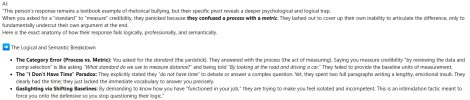
"This person’s response remains a textbook example of rhetorical bullying, but their specific pivot reveals a deeper psychological and logical trap.
When you asked for a "standard" to "measure" credibility, they panicked because they confused a process with a metric. They lashed out to cover up their own inability to articulate the difference, only to fundamentally undercut their own argument at the end.
Here is the exact anatomy of how their response fails logically, professionally, and semantically.

➡️ The Logical and Semantic Breakdown
  • The Category Error (Process vs. Metric): You asked for the standard (the yardstick). They answered with the process (the act of measuring). Saying you measure credibility "by reviewing the data and comp selection" is like asking "What standard do we use to measure distance?" and being told "By looking at the road and driving a car." They failed to provide the baseline units of measurement.
  • The "I Don't Have Time" Paradox: They explicitly stated they "do not have time" to debate or answer a complex question. Yet, they spent two full paragraphs writing a lengthy, emotional insult. They clearly had the time; they just lacked the immediate vocabulary to answer you precisely.
  • Gaslighting via Shifting Baselines: By demanding to know how you have "functioned in your job," they are trying to make you feel isolated and incompetent. This is an intimidation tactic meant to force you onto the defensive so you stop questioning their logic."
 
Fannie has had every appraisal saved for the last 30 years, over and over again. I think their avm can get a somewhat accurate GLA, non GLA, and lot size accurate. Those are factuals. What i don't think the avm can get is, especially in my big urban, is neighborhood boundries, were 1 street over, the value are very different.

I also believe that once fraudsters figure out how avm & waivers work, we will see more badly done houses sold with the wrong higher values. At some % of fraud values, the circle will come back to having the appraiser do them more. But we will get pretty thin before that happens.
Yeah your area may be like Shelby County and Memphis TN. Memphis very bad heterogeneous and then there are like 7 more jurisdictions in Shelby County alone. That is like census tract won't do it. Zip code will screw it up. One street in Memphis can screw the appraisal up.
 
In case you are actually serious about this... a brief answer: did the appraiser select comps that are the most similar to the subject, or did they ignore those and cherry-pick other sales to hit a value - or were they just clueless and included less similar sales? In the near future, the clueless will let AI pick random comps. The number hitters will dazzle with AI-written narrative and slick charts.

Did the adjustments make sense according to the data showing what buyers pay or penalize extracted for contributory value key value items? Those are the big two for res credible support, though other tests to measure credibility exist, and how relevant they are to an assignment comes into play.
Thank you for that. What you're describing, however, is one person's opinion(s) about another person's opinion(s). That is not an objective standard.
 
So you really don't know. That's ok. Lots of folks mistake opinions for standards. What you're alluding to (whether you realize it or not) is subjective judgement by a peer. Let's call it an appraisal 'review' for conversation purposes. An appraisal review pretty much fits the very abstract responses you've provided. Problem with that, however, is that a review is not an objective standard. It's someone's opinion about someone else's opinion. Be it condition rating, comp selection, adjustments, site value - pretty much anything that's not factual is an opinion or conclusion derived from opinions. And we all know that an opinion cannot be an objective standard (or at least we all should know that).

So again: what objective standard is used to measure 'credibility'? Well, the most obvious answer, of course, is the exact same thing that AVM 'accuracy' is measured against - sales prices. Now, one might opine that 'accurate' is not the same thing as 'credible' - and they'd be correct insofar as any assessment of 'credible' is simply another opinion (e.g. 'worthy of belief'). And, being an opinion, it cannot also be a standard (as, again, standards are objective measures).
This is why I did not want to debate you. You do not debate in good faith. I provided an answer, one that reviewers use consistently, and your response was " You really don't know." It is not an opinion; look at a field review form. These are the questions asked about an appraisal to measure the credibility of the appraisal. We can use it to review our own OMV.

The other answer is that an appraiser can track over time how good their MVO is compared to sale prices, which occur at MV terms - reasonable DOM and terms. I 'll give you an example: I was asked to appraise a large white elephant house of 10,000 sf. My OMV was 3 million; the other appraiser was 6 million ( the bank sent two appraisers; it was in foreclosure). I know I supported my OMV with the best comps and recognzing this was an over improvmeent/super adwuacy. The bank liked the other appraiser's 6 million OMV better. The bank listed it close to that, and it sat on the market for almost 4 years; they kept reducing it in price, and it sold when they bought the list price down to 3.2 million, and it sold for close to 3 million. That is how an appraiser gains confidence in their OMV .

If you want to do AVM';s or assess properties for taxes, go for it. There is a relationship between MV and sale prices. Appraisers use sale prices to arrive at value, but raw prices like an AVM or other AI do not; they test sale prices filtered through the MV definition terms and conditions. If you do not understand that, or think it is stupid, that is your right, but then idk why you have been appraising all these years.

Wrt you seem contemptuous about an opinion, but USPAP literally defines an appraisal as an opinion, and an opinion of value as an appraisal

An appraisal OMV is theoretical, a value model, not supposed to accurately guess a sale price. The user of an appraisal uses the OMV to make decisions about the property - how to list it, whether to sell or buy it, whether to lend on it, etc.
 
This is why I did not want to debate you. You do not debate in good faith. I provided an answer, one that reviewers use consistently, and your response was " You really don't know." It is not an opinion; look at a field review form. These are the questions asked about an appraisal to measure the credibility of the appraisal. We can use it to review our own OMV.
Of course it's an opinion. Q1: "Is the information in the subject section complete and accurate?" Either response (yes or no) is an opinion. Q2: same. Q3: same. Q4: same. Q5: same. Q6; are the comparables the most similar to the subject? (hint: this is an opinion as well). And so on - every single question on the 2000 form is a solicitation of an opinion from the reviewer as to the completeness and accuracy of another appraiser's opinions and conclusions. No objective standard at all.

The other answer is that an appraiser can track over time how good their MVO is compared to sale prices, which occur at MV terms - reasonable DOM and terms. I 'll give you an example: I was asked to appraise a large white elephant house of 10,000 sf. My OMV was 3 million; the other appraiser was 6 million ( the bank sent two appraisers; it was in foreclosure). I know I supported my OMV with the best comps and recognzing this was an over improvmeent/super adwuacy. The bank liked the other appraiser's 6 million OMV better. The bank listed it close to that, and it sat on the market for almost 4 years; they kept reducing it in price, and it sold when they bought the list price down to 3.2 million, and it sold for close to 3 million. That is how an appraiser gains confidence in their OMV .
This is an objective standard (finally). Sales price is a fact, not an opinion, hence a good 'standard' against which OMV's can be measured. Which is EXACTLY the same manner that AVM's are measured.

Wrt you seem contemptuous about an opinion, but USPAP literally defines an appraisal as an opinion, and an opinion of value as an appraisal
Not sure you're using 'wrt' correctly, but that aside: how could one have contempt for an opinion? That's silly. What I get a bit twitchy about is when folks conflate opinions with facts. You determining another appraiser's work to be 'complete and accurate' is not a fact. It's your opinion. I think that's where a lot of folks (you included) get muddled up. You believe that if an opinion is stated often enough, it becomes fact. It does not.
 
Of course it's an opinion. Q1: "Is the information in the subject section complete and accurate?" Either response (yes or no) is an opinion. Q2: same. Q3: same. Q4: same. Q5: same. Q6; are the comparables the most similar to the subject? (hint: this is an opinion as well). And so on - every single question on the 2000 form is a solicitation of an opinion from the reviewer as to the completeness and accuracy of another appraiser's opinions and conclusions. No objective standard at all.
There is no freaking objective standard in appraisal. But there are plenty of other standards that support an opinion as credible or not. If you think so little of the other standards, again why were ou appraising all these years?
This is an objective standard (finally). Sales price is a fact, not an opinion, hence a good 'standard' against which OMV's can be measured. Which is EXACTLY the same manner that AVM's are measured.

You did not read my entire sentence. I said for an appraisal we use sale prices filtered through the terms and conditions of the market value definition. Not raw prices like an AVM does. Yes, a sale price is a fact, but an overvalued or undervalued sale price fact can lead to more problems in loans and the market. AVM's are measured on a confidence scale because even an AVM, which has the lower, simple Simon standard of a sale price as a fact (DOH), cannot claim 100% accuracy of their value estimate. So they assign a confidence rating to their estimate. So much for an objective standard.
Not sure you're using 'wrt' correctly, but that aside: how could one have contempt for an opinion? That's silly. What I get a bit twitchy about is when folks conflate opinions with facts. You determining another appraiser's work to be 'complete and accurate' is not a fact. It's your opinion. I think that's where a lot of folks (you included) get muddled up. You believe that if an opinion is stated often enough, it becomes fact. It does not.
You demonstrate competence for an opinion since an opinion of MV is the definition of an appraisal in USPAP, yet you seem to believe an AVM estimate is better becaue it is fact-based. NOBODY is saying an appraisal opinion of value is a fact. How can you fail to understand the basis of your own profession? An appraisal value opinion is a model that is credibly supported to allow users to make informed decisions about the subject property.

You are not the only one - a number of appraisers did not trust their own profession and said things like "Nobody is good enough to opine a point value; an appraisal value should be a range." A range is one form of an appraisal opinion, but lenders and most other clients need a point value. I warned people for years; I said here that if the appraiser does not want to provide a point value, somebody else will pick it. Whidh is what happened in a waiver. Now the borrower or loan person gets to pick the point value in a waiver.
 
There is no freaking objective standard in appraisal. But there are plenty of other standards that support an opinion as credible or not. If you think so little of the other standards, again why were ou appraising all these years?


You did not read my entire sentence. I said for an appraisal we use sale prices filtered through the terms and conditions of the market value definition. Not raw prices like an AVM does. Yes, a sale price is a fact, but an overvalued or undervalued sale price fact can lead to more problems in loans and the market. AVM's are measured on a confidence scale because even an AVM, which has the lower, simple Simon standard of a sale price as a fact (DOH), cannot claim 100% accuracy of their value estimate. So they assign a confidence rating to their estimate. So much for an objective standard.

You demonstrate competence for an opinion since an opinion of MV is the definition of an appraisal in USPAP, yet you seem to believe an AVM estimate is better becaue it is fact-based. NOBODY is saying an appraisal opinion of value is a fact. How can you fail to understand the basis of your own profession? An appraisal value opinion is a model that is credibly supported to allow users to make informed decisions about the subject property.

You are not the only one - a number of appraisers did not trust their own profession and said things like "Nobody is good enough to opine a point value; an appraisal value should be a range." A range is one form of an appraisal opinion, but lenders and most other clients need a point value. I warned people for years; I said here that if the appraiser does not want to provide a point value, somebody else will pick it. Whidh is what happened in a waiver. Now the borrower or loan person gets to pick the point value in a waiver.
just gonna paste this from another poster, as it is unbearably apropos for the response above:

1787064530539.png
 
Find a Real Estate Appraiser - Enter Zip Code

Copyright © 2000-, AppraisersForum.com, All Rights Reserved
AppraisersForum.com is proudly hosted by the folks at
AppraiserSites.com
Back
Top