

• Welcome to AppraisersForum.com, the premier online  community for the discussion of real estate appraisal. Register a free account to be able to post and unlock additional forums and features.

Assumptions and estimates for when the ANSI measuring standard becomes the rule?

Status
Not open for further replies.
If it were, then everyone measuring would get exactly the same answer- wherein lies the rub. There are likely going to be just as many complaints about size and GLA regardless who, how, or what standard is used to measure by. If measurement were a fact, you wouldn't need a standard.

"Measurement" can be a verb or noun. https://www.merriam-webster.com/dictionary/measurement

"Measurements" would be a set of measurements, possibly different kinds.

A "Measurement Standard" could relate to a system of units or the way certain objects are measured. In the case of ANSI Z765, it relates to the latter, - the act of taking measurements for the living areas of certain kinds of residential structures.

Now suppose you have two appraisers who measure the same house and are off by 500+sf on the living area. It should be possible to send out a "respected" engineer to make a highly qualified measurement to find which appraiser is the most accurate.

But one might ask how we could possibly know that said expert made a correct measurement. - Maybe he was paid a large sum of money under the table to lie.

Well, let me give you an answer.

Have each appraiser draw a floor plan that shows all rooms and wall thickness. Their interior measurements must add up to the exterior. Everything must reconcile. So you can't just be off by one measurement and get away with it. A CAD program will not allow that. If the engineer wants to lie, he will have to make multiple lies and they must all agree with each other. - And it is very hard to get away with such a lie and not be fairly notieable.

In terms of my own experience, when I see a college degreed appraiser botch one measuremnt, I expect to see many more on the floorplan. And I am often shocked. They don't just screw up once of course, - they wind up cascading their error all over the place. Then something doesn't fit with something in the tax assessor records, and they start the "BIG COVERUP" to make their total kind of match the official value - because it would be better that way, less problems. Yes indeed it now MUST match the official GLA, otherwise there could be some nasty repercussions. Everyone needs to sleep good at night. --- Then things get interesting.
 
If it were, then everyone measuring would get exactly the same answer- wherein lies the rub. There are likely going to be just as many complaints about size and GLA regardless who, how, or what standard is used to measure by. If measurement were a fact, you wouldn't need a standard.
No.. because the skill of the person measuring and the standard of precision... nearest foot, nearest tenth.... is also part of what is recorded and used to calculate. That does not change the actual dimesion that is being measured.
 
While I don't think the standard is going to change measuring very much for many appraiser's (except maybe those who don't measure at all, or who round to 1' and call it good, or who never really knew how to measure a house in the first place), the last page of the standard gives the reporting requirements. So if we are physically unable to measure something (remember the precision they are asking for is 0.1') due to obstructions (bushes, structure, terrain, etc.), my understanding is that we are now required to state that measurements rely on estimated dimensions. If we don't then we are not complying with the standard. Is this incorrect? (And if it is incorrect, please use the standard or facts & logic to help me understand) My interpretation is that virtually every house I've ever measured (even to 1") relied on some estimated dimensions.
 
Last edited:
While I don't think the standard is going to change measuring very much for many appraiser's (except maybe those who don't measure at all, or who round to 1' and call it good, or who never really knew how to measure a house in the first place), the last page of the standard gives the reporting requirements. So if we are physically unable to measure something (remember the precision they are asking for is 0.1') due to obstructions (bushes, structure, terrain, etc.), my understanding is that we are now required to state that measurements rely on estimated dimensions. If we don't then we are not complying with the standard. Is this incorrect? (And if it is incorrect, please use the standard or facts & logic to help me understand) My interpretation is that virtually every house I've ever measured (even to 1") relied on some estimated dimensions.
Dont worry about it nobody is good enough to get to 1/10th it all BS -between bushes-thickness of stucco and siding its just not possible so just say your standard is ANSI and be done the measuring police is not coming.
 
Dont worry about it nobody is good enough to get to 1/10th it all BS -between bushes-thickness of stucco and siding its just not possible so just say your standard is ANSI and be done the measuring police is not coming.
I hear you. I have a short paragraph in my reports that describes in general how I typically determine GLA for the subject and comps. It is boilerplate, but I will add to it if there is a significant issue. I am thinking that I should revise my boilerplate to cover the (mostly trivial) estimates and assumptions that need to be made. I would still just use narrative if there is a significant issue in measuring a home. This would mostly be simple, but honestly when it comes to reconciling the sketch to get it to close out (do you tweak an angle or a wall dimension?), I'm not sure if or what to include yet.
 
"Appraiser measured to the nearest inch or 1/10th foot per the ANSI standard, along with ANSI specified areas of inclusion and exclusion for living area and below or above grade . Due to site conditions, as well as software calculation limitations, the final GLA sf might differ from other sources, or public records or MLS representation. Minor variances in measurements and total do not materially affect value. The sketch was done for valuation purpose. See # 2 on limiting conditions page. "

2. The appraiser has provided a sketch in this appraisal report to show the approximate dimensions of the improvements. The sketch is included only to assist the reader in visualizing the property and understanding the appraiser’s determination of its size.

Unless they remove it from future forms of URAR...#2 is our friend.
 
Last edited:
No.. because the skill of the person measuring and the standard of precision... nearest foot, nearest tenth.... is also part of what is recorded and used to calculate. That does not change the actual dimesion that is being measured.
I see your point in that a measurement is not an opinion. And I guess I'd say it was a 'fact' assuming you disclosed the parameters of your undertaking. What type of measuring device you used, what level of granularity you measured to, how you treated offsets/angles, etc. It is also a 'fact', though, that measuring devices can be, and often are, slightly different as regards actual inches and feet... I've seen vinyl tape measures that are so worn out, that they're off a couple of inches by the time you get to 30'.
 
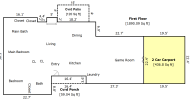
I paid for an assessor's sketch today to see why I had 1890 sf and the assessor had 2015. This is my sketch. No errors Terrel. :) Of course, the house was listed as a three bedroom house. They put a toddler bed in the corner of 508 sf garage conversion. I wonder how many appraisers just accept that?
1643072111864.png
 
Last edited:
Here is the assessor's sketch. It is sort of correct, but there is no 32 foot wall on the bottom or 28 foot wall on the top right. Those of you using assessor's sketches I hope are checking their measurements. The barn is 36 x 48 not 40 x 40 either. So, what are you pundits doing when your apples are compared to sour apples from the assessor? The difference was they have a 644 sf garage conversion and it is really only 508 sf.

1643072342590.png
 
Last edited:
Here is the assessor's sketch. It is sort of correct, but there is no 32 foot wall on the bottom or 28 foot wall on the top right. Those of you using assessor's sketches I hope are checking their measurements. The barn is 36 x 48 not 40 x 40 either. So, what are you pundits doing when your apples are compared to sour apples from the assessor? The difference was they have a 644 sf garage conversion and it is really only 508 sf.

View attachment 58677
Apparently not all assessor's offices are the same. Your assessor obviously doesn't measure to ANSI standards. Some county's around here do (and some don't). Granted it can be a mixed bag so I need to look at the comp sketches. It would stink to have to pay for that! I won't pay for a sketch.
 
Status
Not open for further replies.
Find a Real Estate Appraiser - Enter Zip Code

Copyright © 2000-, AppraisersForum.com, All Rights Reserved
AppraisersForum.com is proudly hosted by the folks at
AppraiserSites.com
Back
Top