• Welcome to AppraisersForum.com, the premier online  community for the discussion of real estate appraisal. Register a free account to be able to post and unlock additional forums and features.

Evaluations 1, Appraisals 0

Status
Not open for further replies.
Speaking of the incomes in the next 10 being better than the last 30, I went back to that H-3 table of historical median incomes so see what the average rates on income increases look like for 2016 income (last ones they reported) over 10, 20,30, 40 and 49 year spans (table stops at 1967).

3rd quintile
1.88% : 2006 - 2016
2.39% : 1996 - 2016
2.84% : 1986 - 2016
3.83% : 1966 - 2016
4.34% : 1967 - 2016

4th quintile
1.69% : 2006 - 2016
2.65% : 1996 - 2016
3.05% : 1986 - 2016
4.09% : 1966 - 2016
4.63% : 1967 - 2016


Notice any pattern?
 
I havn't had a change to dig into the income data and compare it with home prices yet but income growth has been slow since the 70's yet prices have been increasing since that time so that means there are other factors that are not being accounted for when measuring affordability.
 
Well, there's the rise of the 2-income household, which fueled the big jump in the 1970s and 1980s. But having already gone to 2 incomes we can't go from 1 to 2 again; so that's a one time bump. And then there's the other big factor that Randolph already mentioned, which is the financing.

https://fred.stlouisfed.org/graph/?g=NUh

People don't buy the price, they buy the payment. You weren't in the business prior to the 2000s so you probably don't remember that the sub-6% interest rates (we're now down to 4% and less) didn't ever occur prior to 2002.

Average mortgage interest rates by decade

1970s - 8.86% (~7.3% - 12.9%)
1980s - 12.57% (12.9% - 18% then back down to 9.8% at the very end of the decade)
1990s - 8.11% (9.8% to 9% in 1991, then kept dropping to 7.4% in 1999)
2000s - 6.35% (kept dropping from 8.1% - 5.14%)
2010s - 4.05% (bottomed out at 3.5% in 2016 and has increased a little since then)

So if you want to know why the income multipliers are higher now that in 2000, one reason is that the average interest rates in 2000 were 8.05%, and the average in 2016 was 3.65%.

remember the income multipliers from 2007, which we're approaching again in 2018? The average interest rate for 2007 was 6.34%, which by my count is way higher than the current rate of 4.5%.


So given all that, where do we go from here? The rate of income increases has been in decline for many years now. Do we assume interest rates will decline again, and if so how low can they go without getting eaten up by the real inflation rate?
 
Last edited:
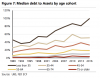
Median Debt to Assets by Age.png
1 In 4 Millennials Rely On Their Parents To Pay Some Bills – Even While Working Full Time


http://www.worldconspiraciesnews.co...-pay-some-bills-even-while-working-full-time/


There is no way going forward that income growth will support debt levels and debt growth. You will notice how sad the millennials situation really is.

Pensions are enormously underfunded. Income won't be there because the ROI on investments have been ruined by QE and zero interest rates.
 
Worldconspiraciesnews.com? :rof:

Pretty much explains everything.
 
I don't know. Maybe you guys are right. Personally, I have to stay bullish on home prices until I see active listings starting to increase.
 
  • Like
Reactions: DTB
Worldconspiraciesnews.com? :rof:

Pretty much explains everything.

Mom and Dad foot some bills for 1 in 4 millennials working full time
  • Millennials earned about 20 percent less in 2013 than baby boomer did at their age in 1989.
  • They also shoulder the bulk of the $1.4 trillion in outstanding student loan debt.
  • If a young adult needs financial help from their parents, the reasons why should be explained.
https://www.cnbc.com/2018/03/05/par...quarter-of-millennials-working-full-time.html


Supporting Adult Kids May Cost Parents $227K in Retirement

https://www.nerdwallet.com/blog/study-lifetime-cost-supporting-adult-children/


Millennials are being 'left behind,' and it poses a huge risk to the US economy

http://www.businessinsider.com/mill...huge-risk-to-the-us-economy-2017-10?r=UK&IR=T


median-debt-to-assets-by-age-png.35041


Take note:

FED SCF = Federal Reserve Survey of Consumer Finance https://www.federalreserve.gov/econres/scfindex.htm

UBS = a Swiss bank, https://www.ubs.com/us/en.html

No matter who publishes the article on millennials, they are using the above as the source.

Maybe you should read more to validate your world view? :)
 
Like I said, we had a 1000+ page thread on this stuff during the last bust, with the same people taking the same positions based on the same types of analyses.

In my opinion the financing element could easily trigger the next bull-to-bear transition. Not that it matters to me one way or the other which direction the market is going. I still work off of what buyers and sellers are actually doing today, not what I'd do if I were in their place. What I will say is that

$244,950 avg home price* in 2007 x avg 6.35% interest rate = monthly P&I pmt of $1524 x 12 = $18,289/yr. That's 36.6% of the 3rd quintile max and 23% of the 4th quintile max.

$305,125 avg home price in 2016 x avg 3.65% interest rate = monthly P&I pmt of $1395 x 12 = $16750/yr. That's 28.3% of the 3rd quintile max and 17.6% of the 4th quintile max. This was 2 years ago.


So even though the income multipliers from the pricing look similar, the effects of the financing have enabled higher payments. Contrast that with the 2011 numbers

$224,000 avg home price in 2011 x avg 4.45% interest rate = monthly P&I pmt of $1128 x 12mo = $13,536/yr. That's 23% of the 3rd quintile max and 14% of the 4th quintile max.
-------------------------------------
The current rate is almost 1% higher than the 2016 average. As I've been saying, there is a right time to buy RE, but "now" isn't always it.


* (average for all 4 quarters of each year)
 
Last edited:
I don't have a source to look at the closed sales and active listings trends leading up to 2006-2008 but I bet declining sales and increasing listings nailed the top.
 
Anyways if there is a pull back in prices I generally agree with you that it would be more like 90's than 2000's. I don't think we are getting even that soon. I am thinking what is likely is in the areas that lead price increases from the bottom start to stabilize and prices start increasing in areas that have not recovered yet.
 
Status
Not open for further replies.
Find a Real Estate Appraiser - Enter Zip Code

Copyright © 2000-, AppraisersForum.com, All Rights Reserved
AppraisersForum.com is proudly hosted by the folks at
AppraiserSites.com
Back
Top