
Terrel L. Shields
Elite Member
- Joined
- May 2, 2002
- Professional Status
- Certified General Appraiser
- State
- Arkansas
I am not swayed by heirs, period.The one who wants lower or higher will influence appraisers.

 community for the discussion of real estate appraisal. Register a free account to be able to post and unlock additional forums and features.

I am not swayed by heirs, period.The one who wants lower or higher will influence appraisers.

Don't worry. No heirs will hire you.I am not swayed by heirs, period.
I do about as many appraisals for estates as for banks. I don't recall ever being refused a job because I wasn't crooked enough to suit an heir. The heirs do not choose the appraiser. The trustee of the estate does and that might be an heir, but they have a judiciary responsibility to accurately value an estate or face court from the other heirs.Don't worry. No heirs will hire you.
Terrel, you're unique because few appraisers work in your area and specialty. Thus, you get most of the business in your area.I do about as many appraisals for estates as for banks. I don't recall ever being refused a job because I wasn't crooked enough to suit an heir. The heirs do not choose the appraiser. The trustee of the estate does and that might be an heir, but they have a judiciary responsibility to accurately value an estate for face court from the other heirs.

Again - it's ok if you don't understand the concepts. That doesn't change the fact that they are correct, though.Sorry, but imo your reasoning is very off for an appraiser. It sounds like you well well-suited to be a statistician or accountant or on the management side.
Rounding has nothing to do with a range. Rounding is accepted peer practice as well as reflecting the reality that, a majority of the time prices for properties are whole numbers/rounded. ( an exception being builder sales ) Appraisers are opining a value, not a price rung up cash register style to the penny or dollar.
You're saying 280k or 279.999 why is one better than the other? ( to prove a point ) is inane. Appraisers are not making those kinds of decisions. Appraisers might be trying to decide is 283k or 290k a better OMV and should have a reason for one over the other.


The identification is that you do not understand the concepts, because the examples you provide are irrelevant to appraisals.Again - it's ok if you don't understand the concepts. That doesn't change the fact that they are correct, though.
J: "You're saying 280k or 279.999 why is one better than the other? ( to prove a point ) is inane. Appraisers are not making those kinds of decisions."
AB: Of course they are. Any time an appraiser opines to a point value, they're implicitly stating they choose that value over any other value in their range. Words have meaning and numbers have meaning. $280,000 is a different number than $279,999. The fact that you chose $280k and didn't choose $279k means you implicitly valued $280k more than you did $279k. You're still opining to the penny...
I agree that rounding is a construct of the perceived accuracy.Appraisers are not trying to choose between $ 280,000 and $279,999!!!
But values are numbers. That does not change the fact that there is a statistical range of probable values, and from that range you, the appraiser, will choose a number. Statistically, they are not different. It is solely your heuristic judgment which finalizes your point value within the range. But if that point value does not lie within the statistical mean, then the data are less than good. And in that case, even your judgment would be suspect. Usually in residential suburban situations you'd have a number of sales and from that population of selected sales, you would have a rather tight range. And almost certainly, adjusted, the point value you choose is going to fall within that range.They are VALUES
If the adjusted value range of the comps was 270k -285k, the problem for the appraiser is not whether to opine at $279,999 or $280,000. The appraiser might struggle with whether to opine close to the lower end of the 170k range or a midpoint of 176 -180k or toward the higher end of 285k. There is no way to claim that 271k is just as valid as 284k for a property just because they both happen to fall within the range.J: "You're saying 280k or 279.999 why is one better than the other? ( to prove a point ) is inane. Appraisers are not making those kinds of decisions."
AB: Of course they are. Any time an appraiser opines to a point value, they're implicitly stating they choose that value over any other value in their range. Words have meaning and numbers have meaning. $280,000 is a different number than $279,999. The fact that you chose $280k and didn't choose $279k means you implicitly valued $280k more than you did $279k. You're still opening to the penny...
Values are not JUST numbers. If that were true, we would be solving a math problem, not an appraisal marketability problem. It is not about picking a number. A value is expressed as a $ amount price, not as a "number "- a number is digits, and could mean how many apples or how many pounds something weighs.I agree that rounding is a construct of the perceived accuracy.
But values are numbers. That does not change the fact that there is a statistical range of probable values, and from that range you, the appraiser, will choose a number. Statistically, they are not different. It is solely your heuristic judgment which finalizes your point value within the range. But if that point value does not lie within the statistical mean, then the data are less than good. And in that case, even your judgment would be suspect. Usually in residential suburban situations you'd have a number of sales and from that population of selected sales, you would have a rather tight range. And almost certainly, adjusted, the point value you choose is going to fall within that range.
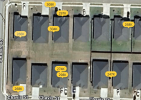
So, in the sales below is a Horton subdivision and all new sales within a span of some 18 months the sold prices range from 247 - 308k. That is the gross range unadjusted and adjusted for SF (which is about the only difference of significance) we probably would tighten up that range, but often two rather identical houses may sell for something different simply by demand or any number of factors. One side by side pair look fairly identical but priced $24,000 different (note the arrows are often not quite correct and show over the same dwelling.) So, what is the difference that we land upon to draw our final conclusion as to a point value. Is it the mean price? The mean of the price per SF? Or, some exterior feature? Perhaps one is all tile or all carpet, or one has 4 fixture bathrooms. It is still our judgment to decide which metric we will weigh to arrive at a final value.