• Welcome to AppraisersForum.com, the premier online  community for the discussion of real estate appraisal. Register a free account to be able to post and unlock additional forums and features.

Where Do You Think "geographic Competency" Begins And Ends?

I am capable of *competently* completing an appraisal assignment on a "typical" SFR even if

  • I've worked in the community before but have never worked in this particular neighborhood

    Votes: 30 52.6%
  • If I've worked in this County before but have never worked in this community

    Votes: 29 50.9%
  • If I've worked in this region before but never in this County

    Votes: 21 36.8%
  • If I've worked in this state before but never in this region

    Votes: 12 21.1%
  • I am capable of figuring out a typical SFR property almost regardless of where it is.

    Votes: 35 61.4%

  • Total voters
    57
Status
Not open for further replies.
The big distinction between accounting and appraising is that - because the nature of the assets involved - the accountant is largely dependent on the accuracy of the information provided by the principal; whereas what the appraiser is dealing with is usually knowable and identifiable on the objective basis even if the principals want to depict it inaccurately. Apart from that they do observe/report on much the same basis that we do.

Within that context, an avoidable error either occurs as a failure of competency (I inadvertentlyscrewed up) or a failure of ethics (I knew better but I did it anyway). You can get a little overlap when it comes to making decisions about how competent you are to undertake an assignment but in broad terms the ETHICS RULE and the COMPETENCY RULE are the big ones, with the SRs being expressions of the front half of USPAP as it applies to the various forms of appraisal and appraisal review.

So when the accounting scandals at Enron became common knowledge hit the accounting profession itself took a big hit in terms of the public trust (in the accounting profession) - and it was attributed to ethical failures. On the large scale, the failures attributed to appraisers during the various RE busts undermine our position.
 
With all that said, it's hard to cheat an honest man. If we provide the appropriate summaries of what we did and didn't do then these clients and their downstream users are capable of understanding what they're looking at within the context and limitations of the SOW we used. So when they *specify* that this is what they want to buy those choices are on them.

Where we run into problems is when we don't do what we said or presented ourselves as doing. Nobody who is reading the report expects the appraisal that was performed by the trainee and countersigned "did not inspect" by the experienced appraiser to have exactly the same level of reliability WRT property attributes as the inspection that was personally performed by the more experienced supervising appraiser.

Same with the drive-by. Nobody expects the exact same results on all of those as a group as would occur with the entire group of appraiser performed an onsite inspection and measured photographed everything. That's why we show our work on those measurements and pix.

Nobody expects the no-look desktop to have the same level of reliability WRT the property attributes as the full monty. Nobody expects the bifurcated appraisal to have that same level as the product where the appraiser personally inspected.

i don't know how far Fannie or some of these other users will take these 1004 alternatives or how widespread their usage will turn out to be. I do expect that these users will measure the performance of these services over time and their measure will figure directly into their criteria for when to use the one and not the other.
 
Last edited:
Bottom line is I don't have a cat in this fight but was appraising long before I had a degree and the only education I received that helped my appraisal business was specialized courses taught by and for appraisers. My education in liberal arts certainly did not help appraising and my first 15 years in the field is what really counted. If I was younger and expanding I would be looking for people that were detailed-honest and willing to learn and I could care less about the degree. Anyway residential appraising is now a production line for many and not a profession because a profession is where you have a business relationship. And that begs the question why would any young or old person spend 4-6 years in college walk out with a $40,000 to $100,000 student loan to become an-appraiser ?

My Position Is:
1- No Degree required.
2- Eliminate Dodd-Frank
3- Eliminate USPAP and create a short concise standard understandable by everyone including the non-appraiser.
4- Allow appraisers to be be advocates for certain non-lender clients as long as clearly disclosed in bold type.
5- Federal Licensing and license would be fully portable to any State In the Union.
 
What an indictment of appraisers! Don't expect anything but crap appraisal reports for those that work for AMCs because these appraisers are weak and basically immoral.

Well said.
Although I've been accused of (and, likely, have been) pompous at times, nothing is more pompous than saying, "if you don't charge what I charge, you are an idiot and must be taking shortcuts."

Now, at the risk of sounding pompous... :ohmy:
I value my work at $X and think I do a good job.
Another might value their work at $Y and feel (and do) the same.
$Y might be more or less than what I charge. If less, and they are willing and able to do the work, why should I care? (Answer: The only reason to care is to see if I might want to re-price my product).

When I first started out, I was willing to work for a lot less then than I am now. Sure, my work wasn't as good as it is now, but it didn't take long to be good enough. I had a choice back then: I could continue to work in the high-volume residential world (which I did for quite a while; and made decent money) or I could take steps to move out of that arena and into others, where the volume was lower and the fees were better. I eventually moved toward choice #2, and have established myself in that arena (although I still do the occasional UAD/GSE work for certain clients).

While I may not always understand "how", at some fees, some appraisers can meet the minimum standards and make a profit, I'm sure that they can at least (in most cases) meet the minimum standards. Certainly, depending on their market area and the types of tools they use to complete their assignments, they are much more efficient than I was (when I had a back-up staff to work in the office and do much of the things that the automated tools now do; the automated tools do them faster and at a lower cost).

And, as I've said before, I'm interested in finding out how they can do it and make it profitable. I'm sure there is a way. I'm equally sure that way is not the path I can take and be competitive. But just because I cannot or would not do it, doesn't mean it cannot and is not done, and done in a compliant manner.

There is a lot of gnashing of teeth about how respect for appraisers is diminishing (or has disappeared). As elitist as the following may make me sound, that is not true in all areas where appraisers work.
In mortgage-finance scenarios, for situations where no one cares about an appraisal report above and beyond that it must meet the compliance standards, that is a situation where the appraisal is considered a regulatory requirement and not a significant part of the lending decision. They already have enough information to make the loan and would make it without the appraisal if they could. But, since they are required to get one, they'll get one and be stuck with it. Most of the time, the appraisal doesn't move the lending needle regardless of where it comes in at (the loan was ready to go prior to the appraisal, and goes once they get the appraisal; no material change to the lending decision because of the appraisal). It is the infrequent times when the appraisal makes a difference (if not, nearly all of our work would be questioned. When, indeed, that isn't the case. And the majority of items they do question some on are compliance issues; not valuation issues).

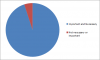
Here (IMO) is an illustration of how appraisals and, by extension, appraisers were viewed in mortgage finance 20+ years ago:
upload_2018-2-25_10-31-46.png

20 years ago there were alternatives; but they were not good enough to act as substitutes for appraisals. So, appraisals and appraisers were considered important in the lending decision-making process because the majority of transactions required an appraisal to value the collateral as part of the risk-equation. Working in the blue area doesn't mean we were necessarily loved, but we were respected for what we did (it was important and necessary).

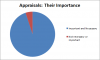
Here we are today:

upload_2018-2-25_10-35-4.png


If we still work in the blue, we are still respected.
If some of our work is in the green, we are considered a regulatory requirement.
We are no longer needed for the work in the red.

That is reality, as it appears to me (others may have a different view).
And, I think it would be good for all of us to keep this in mind in regard to "respect" for what we do: The green section can increase due to regulatory requirements. Regulations will not earn us respect because our users do not see our contribution as being important for those transactions that fall within the green. It doesn't matter how important we see our work to be; if someone is required to purchase something from me that they don't think is important, they are not going to put the same value on that as I am. In those cases, since all I'm purchasing is a compliance document, I'm going to shop based on price for the product that meets the compliance requirements; that doesn't mean I don't care; the appraisal still needs to meet the minimum requirements, but that is the primary quality metric that is significant. This is the dynamic in the "green" area.

Competency, education, ability, is always important in the "blue", and for that work we will be respected.
For the rest, the appraisal just isn't necessary (as judged by our clients); don't expect to get special respect when you are doing something that your client doesn't think is necessary.


The below is taken from a post Mr. Rex made in another thread. I see a similarity to what we do if our clients don't really think what we do is necessary:

th
 

Attachments

  • upload_2018-2-25_10-30-24.png
    upload_2018-2-25_10-30-24.png
    6.6 KB · Views: 1
  • upload_2018-2-25_10-34-37.png
    upload_2018-2-25_10-34-37.png
    7 KB · Views: 1
Last edited:
Faster, better, cheaper. These goals are counter-productive. Don't take a rocket scientist to get to that conclusion.

Thing is, appraisals are better today than they ever have been. Too bad that fact gets over-looked so often. I guess its just more desirable to be morbid and continue to bash a group of blameless people. The sick part is, most of the bashing comes from within. Do you really think that the loans closed and resold with low-fee appraisals are marketed to the secondary participants as being completed by incompetent appraisers?

Its a game people. All of us would be better served to acknowledge that and learn how to play. There is only one move that will provide results that benefit us. Will we ever realize the only option and exercise it? I wouldn't bet on it.

I watched a movie last night called the Magnificent 7, the remake from 2016 or so. The bad guy has a line at the end, when he is describing his rationale for stealing homesteaders land. He says, "If God didn't want those people sheared, he wouldn't have made them sheep."
 
FHA was teaching free CE courses in requirements for FHA appraisals
I took both AR and OK classes every time FHA offered the class, be it Fayetteville, Tulsa, or Oklahoma City.
Nobody expects the no-look desktop to have the same level of reliability
...except the person paying for the appraisal - i.e., the borrower who doesn't normally understand the difference or even why an appraisal needs done.

The effort to separate fee from quality is ludicrous. Basically while claiming shortcut, low cost hybrids are not expected to be as good as "full" URAR reports you claim an equally cheap URAR is just as likely to be as good as a well crafted report costing twice as much? The idea there is any credibility to the concept that some differentiation of "public trust" accrues to appraisers pumping out dodgy low-cost URARs vs. dodgy hybrids seems quixotic at best. You may not get what you pay for but you know you aren't going to get much for $150 regardless the form, processes and procedures used.
 
...except the person paying for the appraisal - i.e., the borrower who doesn't normally understand the difference or even why an appraisal needs done.
When an entity who is typically a borrower in a mortgage finance transaction becomes a client in the non-mortgage finance scenario where they need an appraisal, they care.
In the mortgage finance transaction, if you gave them the following choices:

Based on your loan, we are going to order an appraisal that is two parts: An inspection by a local inspector and then a valuation by a licensed/certified appraiser. Your loan qualifies for this type of appraisal because of [insert reason here].
However, you can always opt for an appraisal where everything is done by the appraiser. The appraisal with an inspection completed by the appraiser usually takes 5 days longer and costs $200 or so more. Please note it is always possible the appraiser who completes the inspection might see something that the inspector doesn't, and that something could make a difference in the appraised value. Furthermore, if you think something significant was missed, you can always opt for the full appraisal afterward but that will require an additional appraisal fee. What would you like us to do?​

What decision would most make?
 
These market participants demonstrate their opinions of reliability by what they buy and use.

It's the secondary market that prices the perceived risks associated with the portfolios they buy. That perception occurring on their end and based on the methods they use to track these things, not on the seller's end.

If BPOs had a better track record we'd be losing more of our market share to them. If 2055s were equated the same as 1004s we'd be doing mostly 2055s, with the 1004 use being limited to the most critical situations.
 
Sellers package their securities based on the appetite of the buyers in the secondary market.
The two go hand-in-hand.
If I mispackage it as a seller, than I'm holding it in my portfolio or taking an unplanned haircut when I do sell it.
 
Faster, better, cheaper. These goals are counter-productive.
As technology advances and/or more competition enters into the market, faster, better and cheaper happens all of the time. When I bought my first desktop computer for my appraisal business, it cost something like $2,000 and took two weeks to be built by the computer shop with with specs I needed ....now I can walk into Best Buy and buy a laptop or desktop in 5 minutes for $400 or $500 that is far superior than that $2,000 computer I bought years ago. There are numerous other examples out there...in the 1970's the US automakers learned a hard lessen that the Japanese were able to build more reliable and better cars faster (due to more automation) that were significantly cheaper and far more reliable than the American cars at the time and Detroit has now spent that last 30 - 40 years trying to close the quality gap.
 
Status
Not open for further replies.
Find a Real Estate Appraiser - Enter Zip Code

Copyright © 2000-, AppraisersForum.com, All Rights Reserved
AppraisersForum.com is proudly hosted by the folks at
AppraiserSites.com
Back
Top