• Welcome to AppraisersForum.com, the premier online  community for the discussion of real estate appraisal. Register a free account to be able to post and unlock additional forums and features.

All Solar, Et Al, In 12 Years?

Status
Not open for further replies.
The truth is we don't know what will happen


Someone is lying. Either they know CO2 is the cause of everything because their computer model says so or reality cannot be predicted by their computer model.
 
No glaciers left in Glacier Park
In California there is a gray rock canyon that a glacier hollowed out. That glacier melted in the 19th century. It is well documented and today the landscape remains bare except for a few whitebark pine that cling to the thin soils. But it also appears that it may well have been melted pre-1200 AD and was re-created by the "Little Ice Age". Southwest of Lake Tahoe, Desolation Valley was scoured by that glacier. And it melted long before Global Warming was supposed to be an issue.

In looking at the chart above, the telling feature is that these warm ups are extremely rapid, being 5 - 10 degrees perhaps in as short a space as 10 years. The mechanism for such change isn't really known. Is it an asteroid strike which typically would be expected to produce the opposite results by throwing dust in the air and blocking the sun? Or is that dust going to create a huge greenhouse effect?

Is the earth a very slow moving uniformitarian world, or does it change in fits and starts as Stephen Jay Gould suggested and is now widely accepted that the world does have sudden changes? What role do sunspots play? And do they play any at all, and if so, what causes sunspots?
 
How could CO2 be the problem? Other than its an easy one to blame us for.

How about shooting rockets and satellites through the ozone made a hole in it.

The world was designed to have CO2,
is the center still molten rock releasing CO2, and other gasses that volcanos shoot into the air?

The whole planet is made up of carbon and oxygen.
 
The whole planet is made up of carbon and oxygen
Mostly nitrogen... But when you look at some asteroid or comet strikes of earth you have to ask the question, "Did that explosion blow away a huge chunk of our atmosphere or not? Most believe that it would - below is a huge crater seen from space which became very evident when the area was flooded for hydroelectric generation. Manicouagan Crater lake is about 50 miles in diameter and the asteroid that caused it may have been over a mile wide.

sgeo_S18.jpg
 
Is the earth a very slow moving uniformitarian world, or does it change in fits and starts as Stephen Jay Gould suggested and is now widely accepted that the world does have sudden changes? What role do sunspots play? And do they play any at all, and if so, what causes sunspots?

Don't forget the deadly solar flare that will knock out all the electrical generation, cell phone and internet signals.

We went through the Dark and Midlevel periods during a warming of the earth prior to the a mini ice age. What caused that warming event? No cars, No smoke stack factories, are we still blaming the cows? Our population reached a height during the same warming period and then was halved (+/-) prior to the mini ice age.

The NASA Earth Observatory notes three particularly cold intervals: one beginning about 1650, another about 1770, and the last in 1850, each separated by intervals of slight warming.[5] The Intergovernmental Panel on Climate Change Third Assessment Report considered the timing and areas affected by the LIA suggested largely independent regional climate changes, rather than a globally synchronous increased glaciation. At most there was modest cooling of the Northern Hemisphere during the period.[10]

.
 
Global Warming Led To Atmospheric Hydrogen Sulfide And Permian Extinction
Date:
March 1, 2005
Source:
Penn State


"The recent dating of the Siberian trap volcanoes to be contemporaneous with the end-Permian extinction suggests that they were the trigger for the environmental events that caused the extinctions," says Lee R. Kump, professor of geosciences. "But the warming caused by these volcanoes through carbon dioxide emissions would not be large enough to cause mass extinctions by itself."

That warming, however, could set off a series of events that led to mass extinction. During the end-Permian extinction 95 percent of all species on Earth became extinct, compared to only 75 percent during the K-T when a large asteroid apparently caused the dinosaurs to disappear.

Volcanic carbon dioxide would cause atmospheric warming that would, in turn, warm surface ocean water. Normally, the deep ocean gets its oxygen from the atmosphere at the poles. Cold water there soaks up oxygen from the air and because cold water is dense, it sinks and slowly moves equator-ward, taking oxygen with it. The warmer the water, the less oxygen can dissolve and the slower the water sinks and moves toward the equator.

“Warmer water slows the conveyer belt and brings less oxygen to the deep oceans,” says Kump.

The constant rain of organic debris produced by marine plants and animals, needs oxygen to decompose. With less oxygen, fewer organics are aerobically consumed.

"Today, there are not enough organics in the oceans to go anoxic," says Kump. "But in the Permian, if the warming from the volcanic carbon dioxide decreased oceanic oxygen, especially if atmospheric oxygen levels were lower, the oceans would be depleted of oxygen."

Once the oxygen is gone, the oceans become the realm of bacteria that obtain their oxygen from sulfur oxide compounds. These bacteria strip oxygen from the compounds and produce hydrogen sulfide. Hydrogen sulfide kills aerobic organisms.

Humans can smell hydrogen sulfide gas, the smell of rotten cabbage, in the parts per trillion range. In the deeps of the Black Sea today, hydrogen sulfide exists at about 200 parts per million. This is a toxic brew in which any aerobic, oxygen-needing organism would die. For the Black Sea, the hydrogen sulfide stays in the depths because our rich oxygen atmosphere mixes in the top layer of water and controls the diffusion of hydrogen sulfide upwards.

In the end-Permian, as the levels of atmospheric oxygen fell and the levels of hydrogen sulfide and carbon dioxide rose, the upper levels of the oceans could have become rich in hydrogen sulfide catastrophically. This would kill most the oceanic plants and animals. The hydrogen sulfide dispersing in the atmosphere would kill most terrestrial life.

"A hydrogen sulfide atmosphere fits the extinction better than one enriched in carbon dioxide," says Kump. "Carbon dioxide would have a profound effect on marine life, but terrestrial plants thrive on carbon dioxide, yet they are included in the extinction."

Another piece in the puzzle surrounding this extinction is that hydrogen sulfide gas destroys the ozone layer. Recently, Dr. Henk Visscher of Utrecht University and his colleagues suggested that there are fossil spores from the end-Permian that show deformities that researchers suspect were caused by ultra violet light.

"These deformities fit the idea that the ozone layer was damaged, letting in more ultra violet," says Kump.

Once this process is underway, methane produced in the ample swamps of this time period has little in the atmosphere to destroy it. The atmosphere becomes one of hydrogen sulfide, methane and ultra violet radiation.

The Penn State researcher and his colleagues are looking for biomarkers, indications of photosynthetic sulfur bacteria in deep-sea sediments to complement such biomarkers recently reported in shallow water sediments of this age by Kliti Grice, Curtin University of Technology, Australia, and colleagues in the Feb. 4 issue of the journal, Science. These bacteria live in places where no oxygen exists, but there is some sunlight. They would have been in their heyday in the end-Permian. Finding evidence of green sulfur bacteria would provide evidence for hydrogen sulfide as the cause of the mass extinctions.

http://www.sciencedaily.com/releases/2005/02/050223130549.htm

Must suck to be a scientist, publish your research, and nobody cares because it does not fit the social agenda.

.
.

 
So back to where I was a few days ago.......

As us creatures breath in oxygen and release CO2, and trees take in CO2 and release oxygen, where is the big push to plant trees, and tear up asphalt to reduce CO2 levels?

Where is the global political push to stop burning the rainforests?
.
 
The world will be saved by technology coming soon

By combining designer quantum dot light-emitters with spectrally matched photonic mirrors, a team of scientists with Berkeley Lab and the University of Illinois created solar cells that collect blue photons at 30 times the concentration of conventional solar cells, the highest luminescent concentration factor ever recorded. This breakthrough paves the way for the future development of low-cost solar cells that efficiently utilize the high-energy part of the solar spectrum.

"We've achieved a luminescent concentration ratio greater than 30 with an optical efficiency of 82-percent for blue photons," says Berkeley Lab director Paul Alivisatos, who is also the Samsung Distinguished Professor of Nanoscience and Nanotechnology at the University of California Berkeley, and director of the Kavli Energy Nanoscience Institute (ENSI), was the co-leader of this research. "To the best of our knowledge, this is the highest luminescent concentration factor in literature to date."

The solar energy industry in the United States is soaring with the number of photovoltaic installations having grown from generating 1.2 gigawatts of electricity in 2008 to generating 20-plus gigawatts today, according to the U.S. Department of Energy (DOE). Still, nearly 70-percent of the electricity generated in this country continues to come from fossil fuels. Low-cost alternatives to today's photovoltaic solar panels are needed for the immense advantages of solar power to be fully realized. One promising alternative has been luminescent solar concentrators (LSCs).

Unlike conventional solar cells that directly absorb sunlight and convert it into electricity, an LSC absorbs the light on a plate embedded with highly efficient light-emitters called "lumophores" that then re-emit the absorbed light at longer wavelengths, a process known as the Stokes shift. This re-emitted light is directed to a micro-solar cell for conversion to electricity. Because the plate is much larger than the micro-solar cell, the solar energy hitting the cell is highly concentrated.

With a sufficient concentration factor, only small amounts of expensive III−V photovoltaic materials are needed to collect light from an inexpensive luminescent waveguide. However, the concentration factor and collection efficiency of the molecular dyes that up until now have been used as lumophores are limited by parasitic losses, including non-unity quantum yields of the lumophores, imperfect light trapping within the waveguide, and reabsorption and scattering of propagating photons.

"We replaced the molecular dyes in previous LSC systems with core/shell nanoparticles composed of cadmium selenide (CdSe) cores and cadmium sulfide (CdS) shells that increase the Stokes shift while reducing photon re-absorption," says Bronstein.

"The CdSe/CdS nanoparticles enabled us to decouple absorption from emission energy and volume, which in turn allowed us to balance absorption and scattering to obtain the optimum nanoparticle," he says. "Our use of photonic mirrors that are carefully matched to the narrow bandwidth of our quantum dot lumophores allowed us to achieve waveguide efficiency exceeding the limit imposed by total internal reflection."

In their ACS Photonics paper, the collaborators express confidence that future LSC devices will achieve even higher concentration ratios through improvements to the luminescence quantum yield, waveguide geometry, and photonic mirror design.

Read more at: http://phys.org/news/2015-09-solar-cell-absorbs-high-energy-fold.html#jCp

Er ... this ain't ready yet and this certainly will cost much more to manufacture than conventional silicon solar panels.

One big problem of solar panels is the watt/area ratio is way too small for use in the city where land is very expensive. Utility scale PV solar generation typical is way out in the desert where there is no value to the dirt, other than endangered species and sacred land for native americans.
 
That, and we got 15 year loans on the panels we bought, like technology would not improve.

But even if these ones get you an hour or two past sunset, with diminished voltage, it does not solve the solar issue, that there is no grid available energy storage system to get us through the night, and through stormy days and nights.

And even if we stop burning fossil fuels all together, the planet still produces CO2, and apparently produces enough CO2 for the planet to have a history of global warming and cooling.

Kool aid, all the way round.

.
 
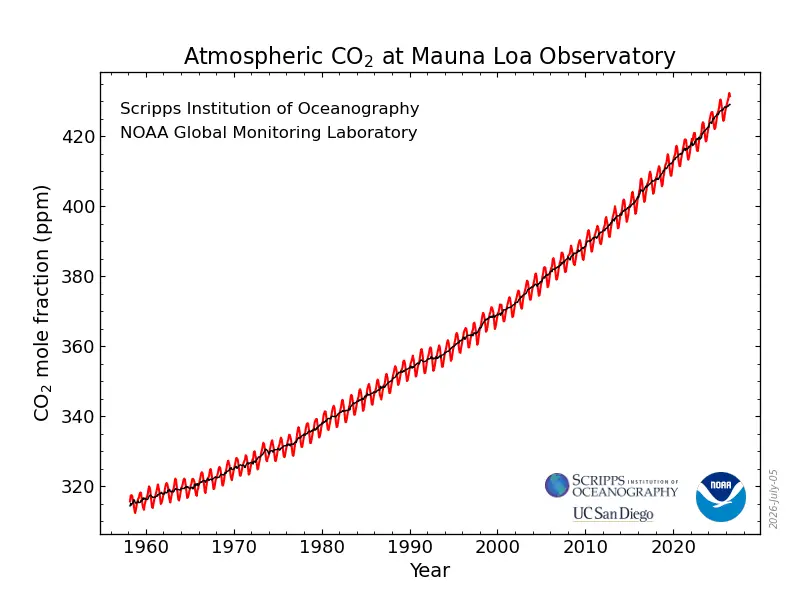
So here is the basics of chemistry. CO2 is less soluble in warm water. It is more soluble in cold water. The water on this planet serves both as a source for CO2 (emissions) and a sink for CO2 (absorption). As temperatures rise, more CO2 is generated by natural emissions from all systems, both land and water. Therefore when the CO2 levels increase, they lag temperature change - CO2 levels do not lead temperature change - from natural sources. Therefore, unless man burns more carbon that what nature produces by an overwhelming amount, temperature change is driving CO2 emissions, not the other way round.

co2_data_mlo.png


WHY DOES ATMOSPHERIC CO2 PEAK IN MAY?

First, the significance of spring is related to the shift of terrestrial plants from barren winter branches to bountiful spring leaves. After the leaves on the trees drop in the fall, the leaf litter and other dead plant material break down throughout the winter thanks to the hard work of microbes. During this decomposition, microbes respire and produce CO2, contributing to atmospheric CO2 levels in the process. Thus over the course of the winter, there is a steady increase in CO2 in the atmosphere. In the spring, leaves return to the trees and photosynthesis increases dramatically, drawing down the CO2 in the atmosphere. This shift between the fall and winter months to the spring and summer results in the sawtooth pattern of the Keeling Curve measurement of atmospheric CO2 such that every year there is a decline in CO2 during months of terrestrial plant photosynthesis and an increase in CO2 in months without large amounts of photosynthesis and with significant decomposition.

May is the turning point between all the decomposition throughout the winter months and the burst of photosynthesis that occurs with the return of leaves to the trees in spring. CO2 measurements all over the globe reflect this pattern of peak CO2 concentration occurring each May, regardless of the level of that peak. Atmospheric CO2 has reached daily peaks of 400 parts per million for the first time this year as a result of the upward trend in CO2 overall, and the first monthly peak will likely occur in May.

https://scripps.ucsd.edu/programs/keelingcurve/2013/06/04/why-does-atmospheric-co2-peak-in-may/

Since most of the land mass in the northern hemisphere, it demonstrates how nature overwhelms man's ability to burn carbon. The only question becomes, where is this CO2 excess coming from?

The politics of global warming dictate all excess CO2 comes from man, not nature.
 
Status
Not open for further replies.
Find a Real Estate Appraiser - Enter Zip Code

Copyright © 2000-, AppraisersForum.com, All Rights Reserved
AppraisersForum.com is proudly hosted by the folks at
AppraiserSites.com
Back
Top