That can't be.
The previous stormy cycle of the weather was due to cleaner air.
That's what they said, so are you now saying the air wasn't cleaner?
You have hit upon the paradox of the global warming hypothesis: clean air with more CO2 or clean air with less CO2?
We know SO2 and particulates generate global cooling, don't we?
Hurricane dynamics and cloud microphysics
Tropical convective clouds play an important part in the Earth's
climate system. Convection and release of
latent heat transports energy from the surface into the
upper atmosphere. Clouds have a higher
albedo than the underlying ocean, which causes more incoming
solar radiation to be reflected back to space. Since the tops of
tropical systems are much cooler than the surface of the Earth, the presence of high convective clouds cools the climate system.
The most recognizable cloud system in the tropics is the
hurricane. In addition to the important climatic effects of tropical weather systems, hurricanes possess enough energy to cause massive death and destruction. Therefore, their
accurate prediction is of utmost importance.
Cloud microphysics are the
physical processes that describe the growth, decay, and fallout of
precipitation particles. In terms of models, cloud microphysics occur on a scale smaller than the grid-scale of the model and have to be parameterized.
The presence of
cloud condensation nuclei (CCN) influences the number of cloud drops that form in a cloud; the more CCN there are, the more cloud droplets that will form. Changes in the CCN concentration and their associated changes in the cloud drop distribution can redistribute the energy within a hurricane.
https://en.wikipedia.org/wiki/Hurricane_dynamics_and_cloud_microphysics
Cloud condensation nuclei
Cloud condensation nuclei or
CCNs (also known as
cloud seeds) are small particles typically 0.2
µm, or 1/100th the size of a
cloud droplet
[1]on which water vapour condenses. Water requires a
non-gaseous surface to make the transition from a
vapour to a
liquid; this process is called condensation. In the atmosphere, this surface presents itself as
tiny solid or liquid particles called CCNs. When no CCNs are present,
water vapour can be supercooled at about -13°C (8°F) for 5-6 hours before droplets spontaneously form (this is the basis of the
cloud chamber for detecting subatomic particles). In above freezing temperatures the air would have to be
supersaturated to around 400% before the droplets could form.
The number and
type of CCNs can affect the lifetimes and radiative properties of
clouds as well as the amount and hence have an influence on
climate change; details are not well understood but are the subject of research.
Sulfate aerosol (SO42− and
methanesulfonic acid droplets) act as CCNs. These sulfate aerosols form partly from the
dimethyl sulfide (DMS) produced by phytoplankton in the open ocean. Large
algal blooms in ocean surface waters occur in a wide range of latitudes and contribute considerable DMS into the atmosphere to act as nuclei. The idea that an increase in global temperature would also increase phytoplankton activity and therefore CCN numbers was seen as a possible natural phenomenon that would counteract
climate change. An increase of phytoplankton has been observed by scientists in certain areas but the causes are unclear.
https://en.wikipedia.org/wiki/Cloud_condensation_nuclei
Volcanic Gases and Climate Change Overview
Volcanoes can impact climate change. During major explosive eruptions huge amounts of volcanic gas,
aerosol droplets, and ash are injected into the stratosphere. Injected ash falls rapidly from the stratosphere -- most of it is removed within several days to weeks -- and has little impact on climate change. But
volcanic gases like sulfur dioxide can cause global cooling, while volcanic carbon dioxide, a greenhouse gas, has the potential to promote global warming.
Eruption of Mount Pinatubo on June 15, 1991
http://volcanoes.usgs.gov/hazards/gas/climate.php
What Does the Sahara Desert Have to Do with Hurricanes?
AUGUST 28, 2014 -- What does the Sahara Desert in Africa have to do with hurricanes in the Atlantic, Gulf of Mexico, and Eastern Pacific Ocean?
You might think this sounds a little crazy because hurricanes are very wet and deserts are very dry, but
if it weren't for this huge, hot, dry region in North Africa, we would see far fewer hurricanes in the United States.
While not the largest or driest of the deserts, the
Sahara has a major influence on weather across the Western Hemisphere.
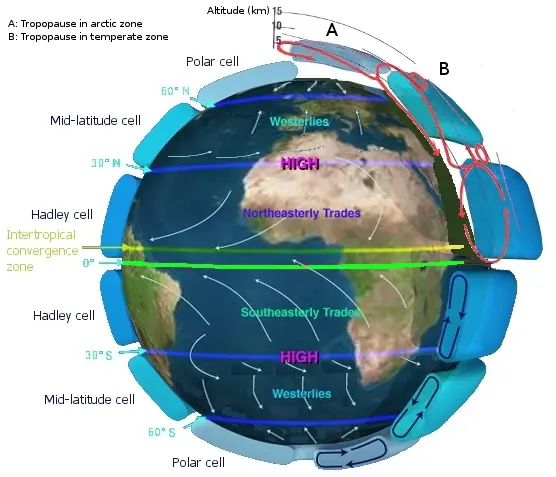
The role the Sahara Desert plays in hurricane development is related to the easterly winds (coming from the east) generated from the differences between the hot, dry desert in north Africa and the cooler, wetter, and forested coastal environment directly south and surrounding the Gulf of Guinea in west Africa. The result is a strong area of high altitude winds commonly called the African Easterly Jet. If these winds were constant, we would also experience fewer hurricanes.
However, the African Easterly Jet is unstable, resulting in undulations in a north-south direction, often forming a corresponding north to south trough, or wave, that moves westward off the West African Coast. When these waves of air have enough moisture, lift, and instability, they readily form clusters of thunderstorms, sometimes becoming correlated with a center of air circulation. When this happens, a
tropical cyclone may form as the areas of disturbed weather move westward across the Atlantic.
Throughout most of the year, these waves typically form every two to three days in a region near Cape Verde (due west of Africa), but it is the summer to early fall when conditions can become favorable for tropical cyclone development.
Not all hurricanes that form in the Atlantic originate near Cape Verde, but this has been the case for most of the major hurricanes that have impacted the continental United States.
http://response.restoration.noaa.gov/about/media/what-does-sahara-desert-have-do-hurricanes.html
Thee other unspoken part is the sand particles that are necessary to form
condensation nuclei which clouds are made from.