
The Premier Online Community for Real Estate Appraisers!
-
Welcome to AppraisersForum.com, the premier online
 community for the discussion of real estate appraisal. Register a free account to be able to post and unlock additional forums and features.
You are using an out of date browser. It may not display this or other websites correctly.
You should upgrade or use an alternative browser.
You should upgrade or use an alternative browser.
Declining market or still stable
- Thread starter timindp
- Start date
- Status
- Not open for further replies.

ZZGAMAZZ
Elite Member
- Joined
- Jul 23, 2007
- Professional Status
- Certified Residential Appraiser
- State
- California
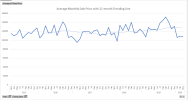
Although charts typically are perceived to be more visually-appealing, a current downward trend seems to be obscured when a linear trend line is used to depict 12-month data, but I don't know enough about data analysis to apply a non-llinear trend line.The market is clearly in decline when activity falls off a cliff. Whether that translates to lower prices is a separate matter. Of course, the MC form is based on the premise of price rules all. But my decision on whether the market price is declining or not is to plot sales over the previous year on Excel, then run a trendline and see if it is increasing, flat, or declining. In my market, for the most part, it is very slightly declining, but again, the total sales volumes are down and I call it a declining market.

JeffSH
Senior Member
- Joined
- Sep 19, 2015
- Professional Status
- Certified Residential Appraiser
- State
- Illinois
IMO the 1004 implies a one-year market conditions history analysis and the boxes in the neighborhood section should match. Just explain what happened over the past year in detail and include the current trends in your commentary.
If prices increased and then cooled, I mark stable. It might be just the winter trends.
If prices increased and then crashed, I mark decreasing. The data is obviously different than a seasonal slump.
if prices are still increasing, I say so. Rare, but it's still happening in a few neighborhoods here.
My commentary is usually something like: "Prices increased tremendously in 2021 and Q1-Q3 2022 as a result of the covid pandemic and lowered interest rates. Recently interest rates have increased dramatically and prices are cooling. Days on market and supply are increasing, but it is still very much a seller's market."
If prices increased and then cooled, I mark stable. It might be just the winter trends.
If prices increased and then crashed, I mark decreasing. The data is obviously different than a seasonal slump.
if prices are still increasing, I say so. Rare, but it's still happening in a few neighborhoods here.
My commentary is usually something like: "Prices increased tremendously in 2021 and Q1-Q3 2022 as a result of the covid pandemic and lowered interest rates. Recently interest rates have increased dramatically and prices are cooling. Days on market and supply are increasing, but it is still very much a seller's market."
ZZGAMAZZ
Elite Member
- Joined
- Jul 23, 2007
- Professional Status
- Certified Residential Appraiser
- State
- California
I'm wondering whether a short-term decrease in prices might be described as "regression to the mean," during a market that consequently could be described as "stable," with further declines below the mean subsequently being described as "descreasing."IMO the 1004 implies a one-year market conditions history analysis and the boxes in the neighborhood section should match. Just explain what happened over the past year in detail and include the current trends in your commentary.
If prices increased and then cooled, I mark stable. It might be just the winter trends.
If prices increased and then crashed, I mark decreasing. The data is obviously different than a seasonal slump.
if prices are still increasing, I say so. Rare, but it's still happening in a few neighborhoods here.
My commentary is usually something like: "Prices increased tremendously in 2021 and Q1-Q3 2022 as a result of the covid pandemic and lowered interest rates. Recently interest rates have increased dramatically and prices are cooling. Days on market and supply are increasing, but it is still very much a seller's market."
JeffSH
Senior Member
- Joined
- Sep 19, 2015
- Professional Status
- Certified Residential Appraiser
- State
- Illinois
This is how I look at it. All historical price models have seasonal fluctuations. My job is to determine if what is being experienced today goes above and beyond what is normal based on looking at the past.I'm wondering whether a short-term decrease in prices might be described as "regression to the mean," during a market that consequently could be described as "stable," with further declines below the mean subsequently being described as "descreasing."
JeffSH
Senior Member
- Joined
- Sep 19, 2015
- Professional Status
- Certified Residential Appraiser
- State
- Illinois
One-dimensional regression (trend line) is too simplistic. The slope of the trend line very rarely matches the actual price increases. Using a moving average is the best method IMO.Although charts typically are perceived to be more visually-appealing, a current downward trend seems to be obscured when a linear trend line is used to depict 12-month data, but I don't know enough about data analysis to apply a non-llinear trend line.

ZZGAMAZZ
Elite Member
- Joined
- Jul 23, 2007
- Professional Status
- Certified Residential Appraiser
- State
- California
I appreciate your response, although it is based upon the principle/presumption that seasonal and any other cyclical change should be discounted when one determines the market status.This is how I look at it. All historical price models have seasonal fluctuations. My job is to determine if what is being experienced today goes above and beyond what is normal based on looking at the past.
JeffSH
Senior Member
- Joined
- Sep 19, 2015
- Professional Status
- Certified Residential Appraiser
- State
- Illinois
True, but in all the thousands of midwest appraisals I've read, commercial and residential, I have never seen someone apply market adjustments for seasonal trends. They always state that the market is seasonal, with most activity and demand occuring in the summer months, but they would never adjust a January comp upward for time when valuing in april. Even if January prices are statistically lower.I appreciate your response, although it is based upon the principle/presumption that seasonal and any other cyclical change should be discounted when one determines the market status.
Honestly I'm not sure why, but it's how I was taught in the midwest and it's how everyone I know does it. Usually the seasonal fluctuations aren't very extreme.
Edit: It's difficult to compare today to how it was 5-10 years ago. Take what I wrote with that in mind. Friend appraiser in Iowa checked the 'stable' box for like 10+ years straight before the shenanigans happened.

Terrel L. Shields
Elite Member
- Joined
- May 2, 2002
- Professional Status
- Certified General Appraiser
- State
- Arkansas
Our seasonality is much muted here compared to other places. The NAR reports sales adjusted for seasonality. We do have higher sales during spring and summer but in 22 the peak was in November well after higher interest rates in one county while price peaked in July in the adjacent county.True, but in all the thousands of midwest appraisals I've read, commercial and residential, I have never seen someone apply market adjustments for seasonal trends. They always state that the market is seasonal, with most activity and demand occuring in the summer months, but they would never adjust a January comp upward for time when valuing in april. Even if January prices are statistically lower.
Honestly I'm not sure why, but it's how I was taught in the midwest and it's how everyone I know does it. Usually the seasonal fluctuations aren't very extreme.
Edit: It's difficult to compare today to how it was 5-10 years ago. Take what I wrote with that in mind. Friend appraiser in Iowa checked the 'stable' box for like 10+ years straight before the shenanigans happened.

Fernando
Elite Member
- Joined
- Nov 7, 2016
- Professional Status
- Certified Residential Appraiser
- State
- California
It's typical seasonality being slow in winter. If you want a good deal, buy now before the Super Bowl (Fernando's tip in getting good deals).
By Spring time, the herd of home buyers will come out increasing demand. Home buyers will by then get use to mortgage rates over 6% (stop dreaming of 3% rates and move on).
So called economic experts expect recession later this year. If true, Spring will be a good home buying season.
By Spring time, the herd of home buyers will come out increasing demand. Home buyers will by then get use to mortgage rates over 6% (stop dreaming of 3% rates and move on).
So called economic experts expect recession later this year. If true, Spring will be a good home buying season.
- Status
- Not open for further replies.