Randolph Kinney
Elite Member
- Joined
- Apr 7, 2005
- Professional Status
- Retired Appraiser
- State
- North Carolina
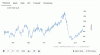
New Home Sales in the United States averaged 650.77 Thousand from 1963 until 2018, reaching an all time high of 1389 Thousand in July of 2005 and a record low of 270 Thousand in February of 2011.
According to the Austrian Business Cycle Theory (ABCT) the artificial lowering of interest rates by the central bank leads to a misallocation of resources because businesses undertake various capital projects that prior to the lowering of interest rates weren't considered as viable. This misallocation of resources is commonly described as an economic boom.
As a rule businessmen discover their error once the central bank—that was instrumental in the artificial lowering of interest rates—reverses its stance, which in turn brings to a halt capital expansion and an ensuing economic bust. From the ABCT one can infer that the artificial lowering of interest rates sets a trap for businessmen by luring them into unsustainable business activities that are only exposed once the central bank tightens its interest rate stance.
Now, a businessman has to cater for consumers future requirements if he wants to succeed in his business.
So whenever he observes a lowering in interest rates he knows that this most likely will provide a boost to the demand for various goods and services in the months ahead. Hence, if he wants to make a profit he would have to make the necessary arrangements to meet the future demand.
For instance, if a builder refuses to act on the likely increase in the demand for houses because he believes that this is on account of the loose monetary policy of the central bank and cannot be sustainable, then he will be out of business very quickly. To be in the building business means that he must be in tune with the demand for housing.
If a businessman has decided to be in a given business this means that the businessman is likely to cater for changes in the demand in this particular business irrespective of the underlying causes behind changes in demand. Failing to do so will put him out of business very quickly.
Hence, regardless of expectations once the central bank tightens its stance most businessmen will “get caught”. A tighter stance will undermine demand for goods and services and this will put pressure on various business activities that sprang up whilst the interest rate stance was loose. An economic bust emerges.
Furthermore, even if businessmen have correctly anticipated the interest rate stance of the central bank and the subsequent changes in the growth rate of money supply, because of the variable time lag from money changes to its effect on economic activity it will be impossible to establish the accurate timing of the boom-bust cycle.
Due to the time lag, prior changes in money supply could continue to dominate the economic scene for an extended period. (Given that the time lag is variable, it is not possible to ascertain when a given change in the money supply growth rate is going to start to dominate the economic scene and when the effect of past changes in money supply is going to vanish).
https://mises.org/wire/how-business-owners-take-cues-interest-rates
Rising interest rates will cause demand to decrease for home purchases as less people can afford to buy. Eventually falling demand will cause businesses to layoff people as businesses over expanded their operations to accommodate the rise in demand that was due to artificial lowering of interest rates.
According to the Austrian Business Cycle Theory (ABCT) the artificial lowering of interest rates by the central bank leads to a misallocation of resources because businesses undertake various capital projects that prior to the lowering of interest rates weren't considered as viable. This misallocation of resources is commonly described as an economic boom.
As a rule businessmen discover their error once the central bank—that was instrumental in the artificial lowering of interest rates—reverses its stance, which in turn brings to a halt capital expansion and an ensuing economic bust. From the ABCT one can infer that the artificial lowering of interest rates sets a trap for businessmen by luring them into unsustainable business activities that are only exposed once the central bank tightens its interest rate stance.
Now, a businessman has to cater for consumers future requirements if he wants to succeed in his business.
So whenever he observes a lowering in interest rates he knows that this most likely will provide a boost to the demand for various goods and services in the months ahead. Hence, if he wants to make a profit he would have to make the necessary arrangements to meet the future demand.
For instance, if a builder refuses to act on the likely increase in the demand for houses because he believes that this is on account of the loose monetary policy of the central bank and cannot be sustainable, then he will be out of business very quickly. To be in the building business means that he must be in tune with the demand for housing.
If a businessman has decided to be in a given business this means that the businessman is likely to cater for changes in the demand in this particular business irrespective of the underlying causes behind changes in demand. Failing to do so will put him out of business very quickly.
Hence, regardless of expectations once the central bank tightens its stance most businessmen will “get caught”. A tighter stance will undermine demand for goods and services and this will put pressure on various business activities that sprang up whilst the interest rate stance was loose. An economic bust emerges.
Furthermore, even if businessmen have correctly anticipated the interest rate stance of the central bank and the subsequent changes in the growth rate of money supply, because of the variable time lag from money changes to its effect on economic activity it will be impossible to establish the accurate timing of the boom-bust cycle.
Due to the time lag, prior changes in money supply could continue to dominate the economic scene for an extended period. (Given that the time lag is variable, it is not possible to ascertain when a given change in the money supply growth rate is going to start to dominate the economic scene and when the effect of past changes in money supply is going to vanish).
https://mises.org/wire/how-business-owners-take-cues-interest-rates
Rising interest rates will cause demand to decrease for home purchases as less people can afford to buy. Eventually falling demand will cause businesses to layoff people as businesses over expanded their operations to accommodate the rise in demand that was due to artificial lowering of interest rates.


 Thanks!