• Welcome to AppraisersForum.com, the premier online  community for the discussion of real estate appraisal. Register a free account to be able to post and unlock additional forums and features.

How Long Do You Think It Will Be?

Status
Not open for further replies.
Housing: With home prices soaring in most markets, this is the best time to be a homeowner since 2005. But there's a downside: Thanks to continued government meddling, the housing market has rarely been more fragile. Is another housing crunch brewing?

We've talked before about the strength of the U.S. economy, particularly after tax cuts kicked in. And that's still true. Unfortunately, 10 years after the 2008 financial crisis, there's one exception: The housing market, which, despite superficial signs of health, remains dysfunctional.

Homeowners are happy now, but they may soon be reeling. The Fed, worried about ultralow 3.8% unemployment and rising incomes, has signaled it could raise rates as many as seven times between now and the end of 2019. Not only would new buyers no longer qualify to buy homes, but homeowners who bought during the Fed's zero-interest rate days might get a severe shock as payments surge and buyer demand dries up. Higher Fed rates followed by a downturn in housing prices would devastate the U.S. economy.

How did we get here? Unfortunately, you can blame government. Neither Fannie Mae nor Freddie Mac, the two mortgage giants that caused the 2007 housing meltdown, were dismantled. Instead, Washington rewarded them with an even larger role than before.

Fannie Mae and Freddie Mac, while still in conservatorship and with the blessing of the Federal Housing Finance Agency, are once again expanding into new products and programs with abandon — and in the process potentially adversely affecting industries, businesses and careers," wrote Edward J. Pinto, co-director of the American Enterprise Institute's Center on Housing Markets and Finance, and Tom La Malfa, a 40-year mortgage industry veteran, in the American Banker.

Only one difference: Now taxpayers own the two housing-finance delinquents. Thus when the next housing meltdown occurs, taxpayers will own it. And they'll have to decide whether to bail out homeowners and banks, or just blame it all on "deregulation" and greedy Wall Street, as happened last time.

In the meantime, despite high home prices, Fannie and Freddie continue to pump money into heavily subsidized mortgages, artificially boosting home prices. This is not how free markets work.

https://www.investors.com/politics/editorials/housing-crisis-inevitable/
 
Housing is dropping, and it's demand-driven not supply-driven. All three housing market reports released two weeks ago showed industry deterioration. The homebuilder "sentiment" index for May, now known as the "housing market" index for some reason, showed its fourth decline since the index peaked in December. The index level of 68 in May was 10 points below Wall Street's expectation. The index is a "soft data" report measuring primarily homebuilder assessment of "foot traffic" (showings) and builder sentiment.

Existing home sales for May reported Wednesday showed the second straight month-to-month drop and the third straight month of year-over-year declines. The month's supply for May increased from April, and at 4.1 months, is above the average month's supply for the trailing 12 months. It's also above the average months supply number for all of 2017.

The primary reason for declining home sales is the shrinking pool of buyers who can afford to support the monthly cost of home ownership. The government lowered the bar for its taxpayer-backed mortgage programs every year since 2014. It lowered the down payment requirement, broadened the definition of what constitutes a down payment (as an example, seller concessions can be counted as part of a down payment), thereby reducing even further the amount of cash required from a buyer's bank account at closing, it cut mortgage insurance fees and it lowered income and credit score restrictions. After all this, the government is running out of people into whom it can stuff 0-3% down payment and 50% DTI mortgages in order to keep the housing market propped up.

MLS data in many zip codes are showing "price change" notices. All of them are price reductions.

Tick-Tick-Tick-Tick-Tick-Tick - BOOM!
 

“During the first quarter, we found that about 50 percent of all existing homeowners had a mortgage rate of 3.75 percent or less,” said Frank Nothaft, chief economist for CoreLogic. “May’s mortgage rates averaged a seven-year high of 4.6 percent, with an increasing number of homeowners keeping the low-rate loans they currently have, rather than sell and buy another home that would carry a higher interest rate.”

If mortgage rates were to rise further, fewer homeowners would want to move. In fact, if today’s homeowners just considering a move were faced with a mortgage rate 1 percentage point higher than their current one, 24 percent would not move, according to a survey by John Burns Real Estate Consulting. Thirty-six percent said they “may not” move. The average rate on the 30-year fixed is now slightly more than 1 percentage point higher than the lows following the recession.

The shortage is most acute at the lower end of the market, where demand is highest and where investors bought thousands of distressed properties during the housing crash, turning them into lucrative rentals.

https://www.cnbc.com/2018/07/02/housing-is-getting-more-expensive-as-home-sellers-retreat.html

The housing shortage statistic is distorted because there is no supply at the very bottom price range.

Mortgage rates are up 1% with 50% of potential buyers saying they won't move out or may not move out of their current home. As interest rates continue to rise, demand is destroyed.

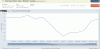
Here are the real stats on existing home sales inventory from the FED which they get from National Association of Realtors:

Housing Inventory.gif

The housing supply has been increasing since December 2017. May had a 4.1 month supply. The lack of demand is why inventory increases.

Tick-Tick-Tick-Tick-Tick-Tick - BOOM!
 
You are hilarious!

You are posting one year worth of months supply. They are saying active listings declining for the past three years, year over year. You are showing only one year worth of data and what you are seeing is seasonal. Do you see that May 2018 is less than May 2017 and April 208 is less than April 2017?

BOOM! :rof:
 
Pending home sales drop for fifth straight month in May
  • Potential home buyers took a step back from entering the housing market in May.
  • Pending home sells fell 0.5 percent compared to April.
  • Sales may not see gains in June either, given the drop in applications for mortgages.
Potential home buyers pulled back from a pricey and competitive housing market in May, signing fewer contracts to buy existing homes. A monthly index of so-called pending home sales from the National Association of Realtors fell 0.5 percent compared with April and was 2.2 percent lower than May of 2017. The expectation was for a 0.5 percent gain.

Sales have now fallen on an annual basis for five straight months. Pending home sales are a forward indicator of closed sales in June and July.

https://www.cnbc.com/2018/06/27/pending-home-sales-drop-for-fifth-straight-month-in-may.html

So you have a rise in inventory of homes for sale for the last 5 months and you have pending sales dropping for the last 5 months. That goes hand in hand with lack of demand.

Tick-Tick-Tick-Tick-Tick-Tick - BOOM!
 
One thing that I've been thinking about lately is exactly how much the tax cuts will boost the economy. Take a simplistic example: $100,000 annual income, 30% tax rate (assume marginal and average tax rates are the same). Say that the marginal/ average tax rate is cut to 25%, so taxes would go from $30,000 to $25,000 before consideration of an economic boost from said tax cut. In order to maintain the same $30,000 tax payment, one's annual income would need to increase to $120,000. That's a 20% increase overall, as well as a 400% appreciation rate from the $5,000 tax savings rate.
I recognize that the above example could be flawed in application to the real world (such as marginal tax rate = average tax rate) and have my own opinion on what kind of boost that this might create, but are there (non-partisan) studies out there that come up with theories on how much of an economic boost the tax cuts will create? Another thing that I was thinking was timing: the tax cuts might in the short term provide a boost that nowhere near offsets the drop in government payments, but in the longer term, it might be somewhat closer to offsetting this drop. Thoughts?
 
One thing that I've been thinking about lately is exactly how much the tax cuts will boost the economy. Take a simplistic example: $100,000 annual income, 30% tax rate (assume marginal and average tax rates are the same). Say that the marginal/ average tax rate is cut to 25%, so taxes would go from $30,000 to $25,000 before consideration of an economic boost from said tax cut. In order to maintain the same $30,000 tax payment, one's annual income would need to increase to $120,000. That's a 20% increase overall, as well as a 400% appreciation rate from the $5,000 tax savings rate.
I recognize that the above example could be flawed in application to the real world (such as marginal tax rate = average tax rate) and have my own opinion on what kind of boost that this might create, but are there (non-partisan) studies out there that come up with theories on how much of an economic boost the tax cuts will create? Another thing that I was thinking was timing: the tax cuts might in the short term provide a boost that nowhere near offsets the drop in government payments, but in the longer term, it might be somewhat closer to offsetting this drop. Thoughts?

The US revenue averages about 26% of GDP as of 2017. US GDP today is about $18.5 trillion. We are trying to go from 2% to 4% GDP growth. If we get to 4% then that is $$740 billion increase in output for the first year and the dollar mount of growth increases each year because of compounding. So in the end, if we are able to get to 4% GDP growth then tax revenue should be blowing past pre-tax cut revenue levels fairly quickly. IMO
 
Reagans Economic Tax Recovery ACt of 1981 hit peak GDP growth rate of 7.3% in 1984. GDP growth rate between 1980 and 1982 averaged about 0%. Last time we saw 4-5% GDP growth rate was 1999.
 
Status
Not open for further replies.
Find a Real Estate Appraiser - Enter Zip Code

Copyright © 2000-, AppraisersForum.com, All Rights Reserved
AppraisersForum.com is proudly hosted by the folks at
AppraiserSites.com
Back
Top